
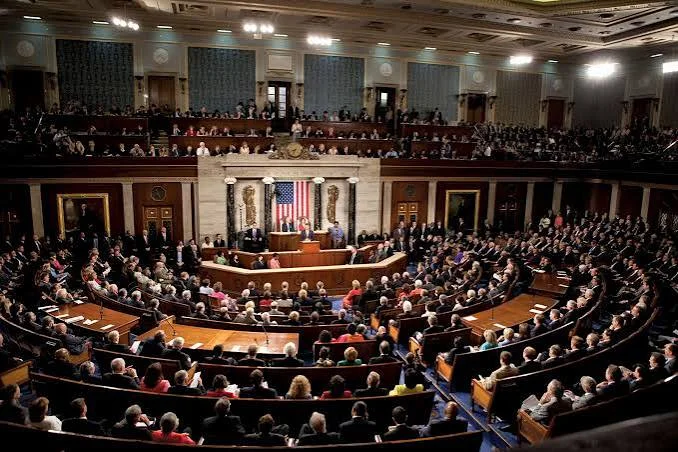
Americans head to the polls on November 3, 2026, in midterm elections that could reshape the balance of power in Washington, determine the future of President Donald Trump's legislative agenda and influence the country's political direction ahead of the 2028 presidential election.
All 435 seats in the House of Representatives and 35 of the 100 Senate seats are being contested, alongside 36 governorships, state legislative positions and hundreds of local offices.
The elections come as Republicans hold narrow majorities in both chambers of Congress, while Democrats are seeking to regain control and strengthen their ability to scrutinise the Trump administration.
Democrats need a net gain of three seats in the House and four in the Senate to secure majorities.
Republicans, meanwhile, are seeking to retain control and prevent the opposition from gaining greater influence over federal legislation, government spending and presidential appointments.
The outcome will determine how much political room Trump has to advance his policies during the final two years of his four-year presidential term.
Midterm elections are held every two years, halfway through a president's four-year term. Unlike presidential elections, voters do not elect a president during the midterms.
Trump's name will not appear on the ballot, but the elections are widely viewed as a measure of public confidence in his administration and its policies.
Approximately 210 million Americans are registered to vote, although turnout is traditionally lower than during presidential elections.
Since 1944, midterm elections have recorded an average turnout of approximately 42 per cent, compared with 58 per cent during presidential election years.
The new Congress will be sworn in on January 3, 2027, and will exercise significant authority over federal spending, judicial confirmations, legislation and oversight of the executive branch.
The House of Representatives has 435 voting seats, with 218 required for an outright majority.
Republicans currently have an effective advantage of 220 to 215, taking into account two vacant seats and an independent member who generally supports the Republican Speaker.
Democrats therefore need to gain at least three seats to take control.
The Senate presents a more complicated contest. Republicans hold 53 seats, while Democrats have 45, alongside two independents who caucus with them.
A party needs 51 seats for a majority, although Republicans can retain control with 50 because Vice President JD Vance can cast the deciding vote in a tied chamber.
Democrats must defend all 13 seats they currently hold in the election while capturing at least four Republican-held seats.
The Senate contest is particularly important because the chamber confirms presidential nominees, including federal judges, Cabinet officials and other senior government appointments.
Pre-election forecasts indicate that Democrats have a stronger opportunity to gain control of the House, while the Senate contest remains more competitive.
The Cook Political Report, in its October 30 assessment, projected that Democrats could gain between 12 and 25 House seats, potentially increasing their representation to 240.
The organisation also described Democrats as slight favourites in the Senate, with seven competitive races potentially determining control of the chamber.
Sabato's Crystal Ball, in its October 27 assessment, identified 225 House seats as at least leaning Democratic, 193 leaning Republican and 17 as toss-ups.
Polling has also indicated a challenging political environment for Republicans.
Silver Bulletin's generic congressional ballot average showed Democrats leading Republicans by 8.9 percentage points on October 30.
An Emerson College national poll put Democrats at 52 per cent among likely voters, compared with 42 per cent for Republicans.
The same poll placed Trump's approval rating at 37 per cent, with 57 per cent disapproving.
However, these forecasts and polls are not election results. Republicans have disputed the polling picture, with House Speaker Mike Johnson expressing confidence that his party would defy historical trends.
Seven closely contested Senate races could determine which party controls the chamber.
Among the Republican-held seats attracting attention are Alaska, where Senator Dan Sullivan faces Democrat Mary Peltola; Maine, where Susan Collins faces Troy Jackson; Kansas, where Roger Marshall faces Adam Hamilton; and Ohio, where Senator Jon Husted is seeking to retain his seat.
Other competitive contests include Texas and Iowa, where open seats are being contested.
Michigan is another important race, with Republican Mike Rogers and Democrat Abdul El-Sayed competing for an open seat currently held by Democrats.
The outcome in these states could determine whether Democrats secure the four additional seats required to control the Senate.
Historical trends provide another important dimension to the elections.
Since 1946, the party occupying the White House has lost House seats in 18 of 20 midterm elections, recording an average loss of approximately 26 seats.
In 2010, during Barack Obama's presidency, Democrats lost 63 House seats and six Senate seats.
In 2018, during Trump's first presidency, Republicans lost 41 House seats, although they gained two Senate seats.
The trend is not absolute. Presidents George W. Bush and Bill Clinton both experienced midterm periods in which their parties gained House seats.
Trump's approval rating, according to the October 30 Emerson poll, adds to the political uncertainty surrounding the Republican campaign.
Voting will take place on Tuesday, November 3, with polling stations closing at different times across the United States.
For audiences in Kenya, the first polling stations in parts of Indiana and Kentucky are scheduled to close at approximately 2am EAT on Wednesday, November 4.
Further closures will follow throughout the morning, with California and Washington closing at approximately 7am EAT and the final polling stations in Alaska closing at approximately 9am EAT.
However, the closing of polling stations does not mean that results will immediately be finalised.
Some states count ballots faster than others, while close contests involving mail-in and provisional ballots could take several days or longer to resolve.
California and Alaska could take weeks to complete their counts in certain races.
A Democratic takeover of either chamber would end unified Republican control of Congress and introduce greater scrutiny of Trump's administration.
If Democrats win the House, they would gain control of congressional investigations, committee leadership and the legislative process.
The House also has the constitutional authority to impeach a president, although removing Trump from office would require a two-thirds majority in the Senate.
A Democratic-controlled Senate could block or delay presidential appointments, including judicial and Cabinet nominations.
Control of Congress would also influence negotiations over the federal budget and government funding, potentially creating disagreements between the White House and lawmakers.
Even if Democrats capture both chambers, Trump would retain presidential veto powers, meaning Congress would need a two-thirds majority in both chambers to override a veto.
The November 3 elections will therefore determine more than the composition of Congress. They will establish the political constraints facing the Trump administration, shape legislative priorities and determine the extent of congressional oversight during the final two years of his presidency.