
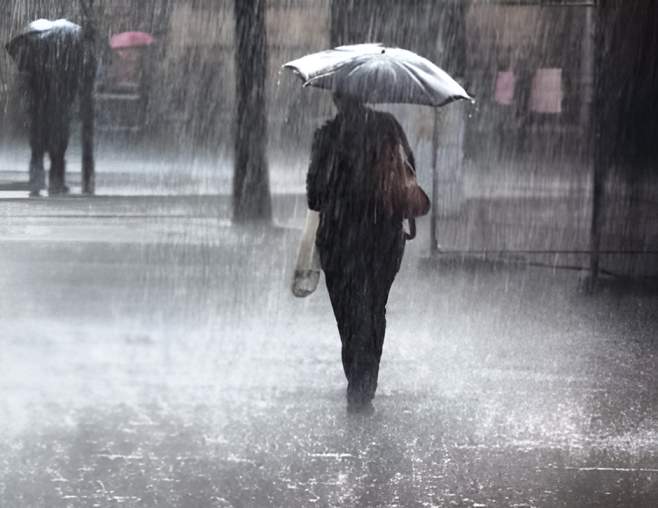
Communities across western and central Kenya have been placed on alert after regional weather experts projected a sustained spell of heavy rainfall that could stretch through the end of June, raising concerns over possible flooding and disruptions in several counties.
The IGAD Climate Prediction and Application Centre (IGAD CPAC), in its weekly outlook issued on June 22, has listed Kenya among countries in the Greater Horn of Africa expected to record above-normal rainfall during the period.
According to the forecast, central and western parts of Kenya are likely to receive rainfall levels higher than usual, with moderate amounts ranging between 50 and 200 millimetres expected in multiple counties.
The western region is expected to be the most affected, with Kisii, Nyamira, Kisumu, Kakamega, Bungoma, Vihiga, Siaya, and Homa Bay all falling within the rainfall zone. In central Kenya, the counties of Nyeri, Murang’a, Kiambu, Embu, Kirinyaga, and Tharaka Nithi are also expected to experience increased rainfall activity.
IGAD says the wet conditions are part of a broader weather pattern affecting several countries in the region, with similar conditions expected beyond Kenya’s borders.
“More than usual rainfall is expected over northern and south-western parts of South Sudan, parts of central to western and northern Ethiopia and isolated areas of both northern Uganda and central to western regions of Kenya,” stated IGAD.
The Kenya Meteorological Service Authority (KMSA) has issued a matching outlook, indicating that rainfall will spread across several regions including the highlands on both sides of the Rift Valley, the Rift Valley itself, the Coast, and parts of North-eastern Kenya.
“Rainfall is expected over the Highlands East and West of the Rift Valley, the Rift Valley, the Coast and parts of North-eastern Kenya,” stated KMSA.
While coastal counties are also expected to receive rainfall, IGAD notes that the amounts will generally remain below 50 millimetres, pointing to lighter showers compared to inland regions and reducing the likelihood of widespread flooding along the coast.
Beyond Kenya, South Sudan is expected to record the most intense rainfall activity, with most areas forecast to receive moderate to heavy downpours. Ethiopia is also projected to experience widespread rainfall in its central, western, and northern regions, while southern areas may receive lighter showers below 50 millimetres. Northern Uganda is expected to see isolated rainfall activity within the same period.
The forecast comes against a wider climate backdrop, after the World Meteorological Organisation (WMO) identified the Greater Horn of Africa as a region that could experience El Niño conditions between October and December, a development that often leads to more extreme and unpredictable weather patterns.