
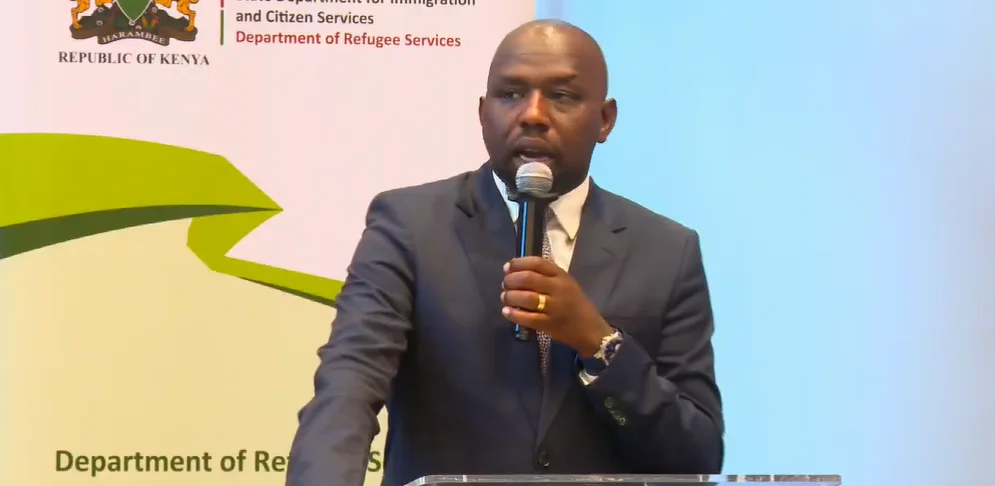
Interior Cabinet Secretary Kipchumba Murkomen has announced plans to overhaul Kenya’s refugee management policy, with a proposed task force expected to develop recommendations within three months amid a sharp rise in the number of people crossing the border from Ethiopia.
The review will examine refugee registration, work permits, asylum procedures and cross-border movements as the government seeks to address emerging challenges in managing refugees and distinguish those seeking protection from people entering the country for employment, education and other opportunities.
Speaking during a meeting with refugee donors in Nairobi on Monday, November 9, Murkomen said the government would establish the task force within two weeks and give it three months to prepare a policy framework that could inform proposed changes to the Refugees Act.
He said the team would assess how Kenya handles refugee status determination and documentation, particularly in light of regional agreements that allow citizens of East African Community member states to move across borders.
Murkomen said the government wanted clearer guidelines on how to classify people entering Kenya, especially those who may qualify for international protection and those seeking to pursue economic opportunities.
“We want to make sure that also from a policy perspective, what category of refugees can be categorised as workers or employees and be given work permits to work,” Murkomen said.
He said the task force would also consider whether employment opportunities should be extended to all refugees or restricted to individuals with specialised skills that could contribute to Kenya’s economy.
The review will seek to balance the economic benefits of allowing refugees to work against the need to protect employment opportunities for Kenyan citizens.
Murkomen's announcement comes as Kenya grapples with a fresh refugee influx from Ethiopia, where renewed insecurity has pushed more than 36,000 people across the border into Moyale within just two weeks.
The CS raised concerns over the pressure the arrivals could place on reception and registration facilities, warning that criminal elements might take advantage of asylum procedures to enter the country.
He called for stronger border controls, security checks and proper registration and documentation to ensure authorities can identify and monitor people entering Kenya.
The proposed changes will also examine how Kenya applies prima facie refugee recognition to people fleeing conflicts in Sudan and South Sudan, alongside the impact of regional agreements on the movement of people across borders.
Kenya's refugee management system is currently guided by the Refugees Act, 2021, which provides for the identification and registration of refugees, access to national services, movement within designated areas and the right to seek employment.
The law also allows the government to grant prima facie refugee status to people from designated groups, while the 2024 Refugees (General) Regulations set out procedures for handling asylum applications, including cases involving individuals who may have previously sought protection in another country.
Murkomen said the review would help address gaps in the existing framework and ensure refugee protection measures respond to changing security and migration challenges in the region.
Beyond policy and border management, the CS urged development partners and United Nations agencies to align their support with the government's Shirika Plan, cautioning against running separate programmes that could lead to duplicated efforts and poor accountability.
The 12-year initiative seeks to shift Kenya's approach to refugee management away from reliance on humanitarian assistance towards greater economic participation, self-reliance and access to integrated services for both refugees and host communities.
The government wants development partners to coordinate their interventions through the plan to ensure resources are directed towards shared priorities and that refugee-hosting communities also benefit from the programmes.