

Kenya has received eight MD-500 helicopters in a trilateral security partnership with the United States and South Korea aimed at strengthening military aviation capabilities and supporting regional peacekeeping operations.
The helicopters were donated by the Republic of Korea, while the United States funded their refurbishment and preparation for service with the Kenya Army Corps of Aviation.
In a press release issued on Monday, the US Embassy said the handover took place in Nairobi on Friday, October 23, as part of a trilateral partnership aimed at strengthening Kenya’s capacity to support regional security and international peacekeeping missions.
US Embassy Chargé d’Affaires Susan Burns said the cooperation reflected a shared commitment to security rather than a one-sided assistance arrangement.
“Our partnership is not about one country doing something for another. It is about countries working with one another toward a shared goal,” Burns said.
She highlighted Kenya’s role in counterterrorism efforts in East Africa, peacekeeping missions across Africa and multinational security operations in Haiti.
“Kenya is on the front lines of regional security and is not simply a beneficiary of international security cooperation. It is a contributor to international security, and a partner whose leadership matters far beyond its borders,” Burns maintained.
“The United States is committed to standing alongside Kenya in that mission,” she added.
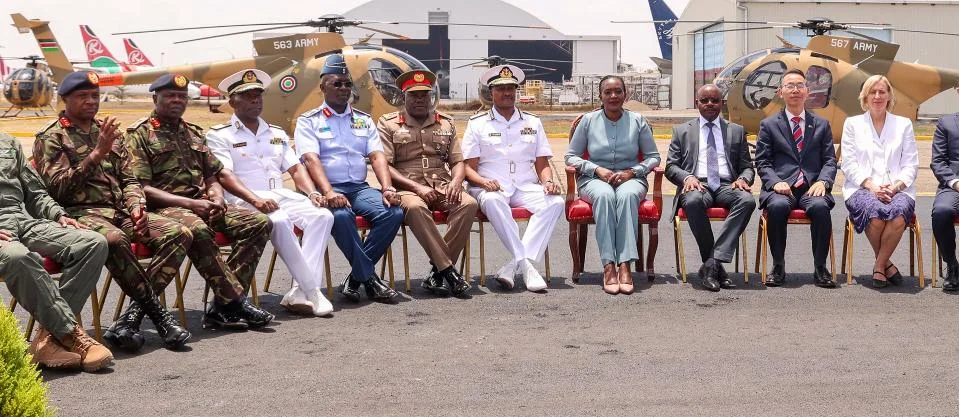
The helicopter handover builds on a commitment made during the December 2021 Seoul Peacekeeping Ministerial, where the United States agreed to explore support for a joint South Korea-Kenya initiative to develop a helicopter unit for United Nations peacekeeping operations.
The initiative seeks to strengthen the aviation capacity available to peacekeepers operating in challenging environments, where air support can be critical to mission effectiveness.
Helicopters enable peacekeeping personnel to reach remote areas, respond to threats against civilians and conduct medical evacuations. They can also support the movement of personnel and supplies in areas where poor roads or insecurity limit ground access.
The acquisition is expected to strengthen Kenya’s military aviation resources, although details on when the helicopters will become operational and the specific missions assigned to them were not provided in the announcement.
The United States said it had invested more than $1.5 billion since 2005 to help partner countries develop capabilities for contributions to United Nations and regional peacekeeping missions.
The three-country partnership also reflects Kenya’s growing involvement in multinational security operations, including efforts to address terrorism and instability beyond its borders.
Burns linked security cooperation to Kenya’s economic development, arguing that stability creates an environment in which businesses can invest, tourism can grow and communities can access more opportunities.
“Security creates stability. Stability creates confidence. And confidence creates the conditions for investment, growth, and prosperity,” she said.
“That is why an investment in Kenya’s security is also an investment in Kenya’s economic future,” Burns added.
The United States said it looked forward to continuing cooperation with Kenya and South Korea to strengthen security capabilities and support a more peaceful and prosperous future.
The handover comes as Kenya continues to participate in regional security initiatives and international peace support efforts, making aviation capability an important component of its operational readiness.
The helicopters are expected to contribute to the Kenya Army Corps of Aviation’s capacity to support military and peacekeeping tasks, including operations in difficult terrain.
The partnership also demonstrates how international security cooperation can combine equipment donations with financial support for refurbishment, helping partner countries prepare military assets for operational use.
Further details on the helicopters’ deployment, maintenance arrangements and operational timelines were not included in the announcement.