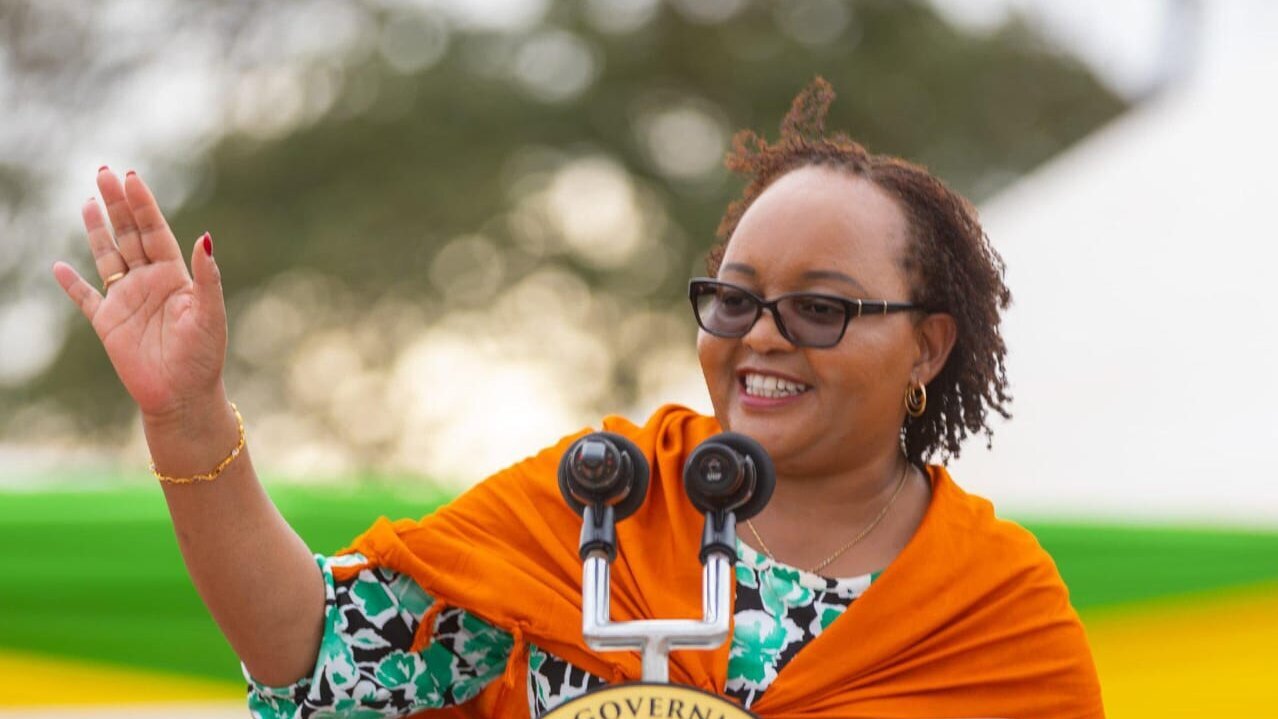
Kirinyaga Governor Anne Waiguru has challenged former Deputy President Rigathi Gachagua’s position as the political kingpin of Central Kenya, arguing that his influence stems from his ability to articulate the region’s grievances rather than widespread support for his presidential ambitions.
Speaking during a Sunday Live interview on Citizen TV, Waiguru said Gachagua had established himself as a leading voice for residents dissatisfied with President William Ruto’s administration but claimed he would not rank among their top five preferred presidential candidates.
Her remarks come against the backdrop of an increasingly contested political landscape in Mount Kenya, where Gachagua has sought to consolidate his influence following his impeachment in October 2024 and subsequent fallout with Ruto.
Since leaving office, Gachagua has emerged as one of the administration’s most vocal critics, frequently raising concerns over political representation, government policies and what he considers the marginalisation of the Mount Kenya region.
His confrontational approach has helped him maintain visibility in the region’s political debate, particularly among sections of the electorate opposed to the government.
Through public rallies and political engagements, he has positioned himself as a defender of Mount Kenya’s interests, challenging leaders perceived to remain aligned with the President.
The former deputy president’s growing prominence has also placed him at the centre of discussions about who speaks for the region and who can mobilise its voters ahead of the 2027 General Election.
However, Waiguru disputed the suggestion that his ability to command attention automatically translates into the status of a political kingpin, drawing a distinction between being a community’s spokesperson and its preferred presidential candidate.
She said opinion polls she had conducted in the Mount Kenya region indicated that residents viewed Gachagua as their leading spokesperson but did not necessarily consider him suitable for the country’s top political office.
“Rigathi Gachagua represents their voice, especially the dissenting voice. So if you ask people in Mount Kenya who they will elect as president, he doesn’t come anywhere in the top five, but when you ask who your spokesperson is, he is number one,” Waiguru said.
The governor maintained that Gachagua’s position as a spokesperson reflected his ability to articulate frustrations among sections of the electorate rather than an established mandate to lead the country.
“That is why I say he’s not a kingpin. They consider him a spokesperson. If you ask them whether they’re going to elect him for president, they say no,” she added.
Waiguru also suggested that the definition of a political kingpin should be linked to presidential ambitions, arguing that such a leader should have sought or be seeking the presidency.
“The reason I hesitated on the kingpin is that the kingpin should be somebody who maybe has sought or is seeking to be the president,” she said.
Her assessment introduces a distinction between regional political influence and national electoral appeal at a time when leaders are seeking to establish their positions ahead of the next election.
Gachagua’s supporters, however, have increasingly presented him as a central figure in the region’s opposition to Ruto, giving him a platform to challenge the administration and rally voters around shared political concerns.
His influence is particularly significant because of Mount Kenya’s electoral importance, with the region’s voting patterns potentially shaping alliances and the balance of power in the 2027 presidential contest.
The competing claims over his status also reflect broader divisions among Central Kenya leaders, some of whom remain associated with the government while others have distanced themselves from the President.
With the next election approaching, the contest over who commands Mount Kenya’s political loyalty is likely to intensify.
Whether Gachagua’s prominence as a critic of the government can translate into a presidential campaign capable of attracting support beyond the region remains a key question in Kenya’s evolving political landscape.