
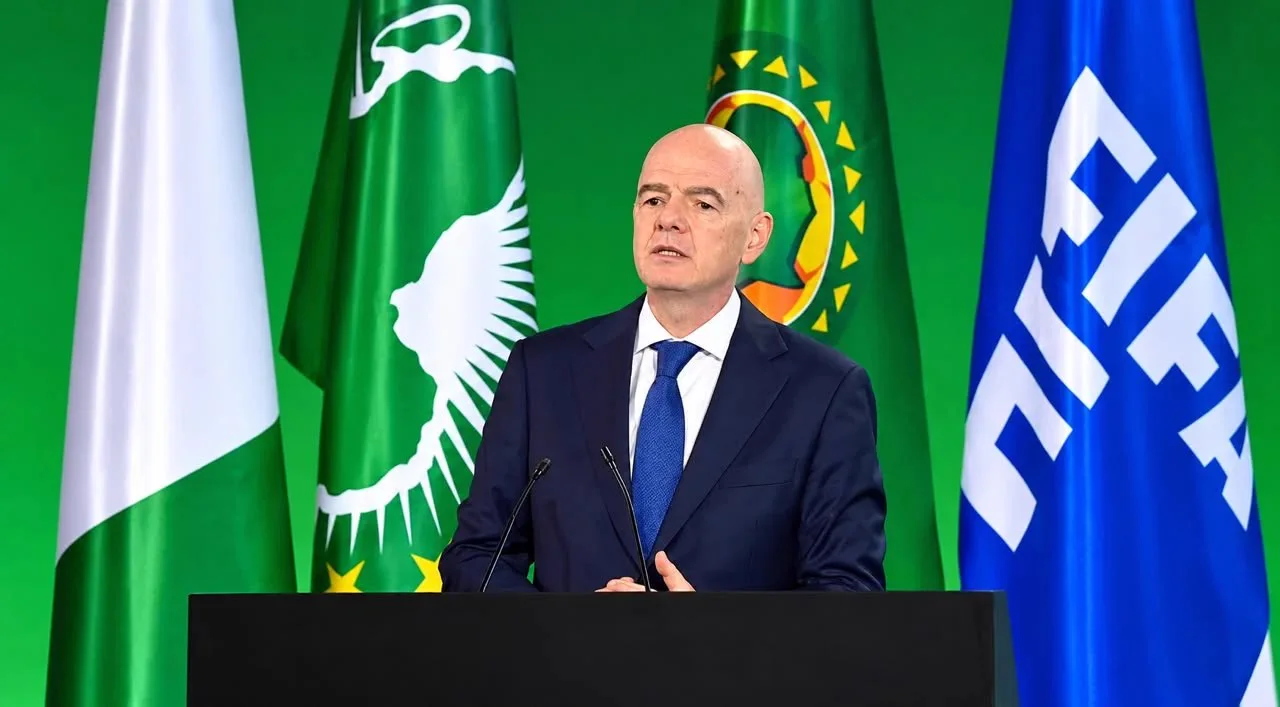
FIFA President Gianni Infantino has announced plans to invest more than Sh193.5 billion in African football over the next four years, with each country set to receive Sh3.225 billion under an expanded funding initiative.
Infantino said the investment would target football development across the continent, including infrastructure, youth programmes, competitions and technical centres, as the global governing body seeks to strengthen Africa's competitiveness in international football.
Speaking during an interview with ARISE News in Abuja on Monday, the FIFA president said the organisation would allocate Sh3.225 billion to every African country, alongside additional financial support for the Confederation of African Football (CAF) and regional football zones.
He said the combined investment would exceed Sh193.5 billion over four years, describing the initiative as a major commitment towards improving football development across the continent.
“Investing Sh3.225 billion in every African country. Plus, we give additional money as well to CAF and to the regional zones as well. This corresponds to more than Sh193.5 billion in only four years,” Infantino said.
The funding is expected to support several areas of football development, particularly facilities and programmes aimed at expanding opportunities for players and strengthening the sport's infrastructure.
Infantino identified technical centres, stadiums, competitions, youth programmes and sporting events as some of the areas that would benefit from the investment.
“A lot can be done with this. Technical centres, stadiums, competitions, youth programmes, events,” he said.
The announcement comes as African football continues to seek greater investment in infrastructure and development programmes to improve the competitiveness of its national teams and provide more opportunities for emerging talent.
According to Infantino, the funding is intended to help African countries reduce the financial gap separating them from wealthier football nations, which have greater resources to support their football programmes.
He acknowledged that the investment would not immediately place African countries on the same financial footing as countries with significantly larger football budgets but maintained that it would bring them closer to competing internationally.
“With these investments, we can give every African country a possibility to compete, not at equal level with those who have hundreds of millions, of course, but at least to come a step closer in narrowing this gap,” he said.
The FIFA president also expressed confidence in the progress already being made by African teams, pointing to instances where countries from the continent had demonstrated their ability to compete successfully against more financially established football nations.
He said the growing competitiveness of African football was evidence that the continent could achieve further success with sustained investment and development support.
“I’m already seeing examples of not only that gap narrowing, but African countries triumphing,” Infantino added.
The proposed investment will also extend beyond individual national football associations through additional funding directed towards CAF and regional football organisations.
This is expected to complement country-level support by strengthening football development initiatives across different parts of the continent.
The four-year funding commitment represents an expanded financial push by FIFA to support African football, with infrastructure, youth development and competitions forming key areas of focus.
Infantino's announcement signals an ambition to give African countries more resources to develop their domestic football structures while improving their ability to compete on the international stage.
However, the impact of the proposed investment will depend on how the funding is distributed and implemented across the continent over the four-year period.