
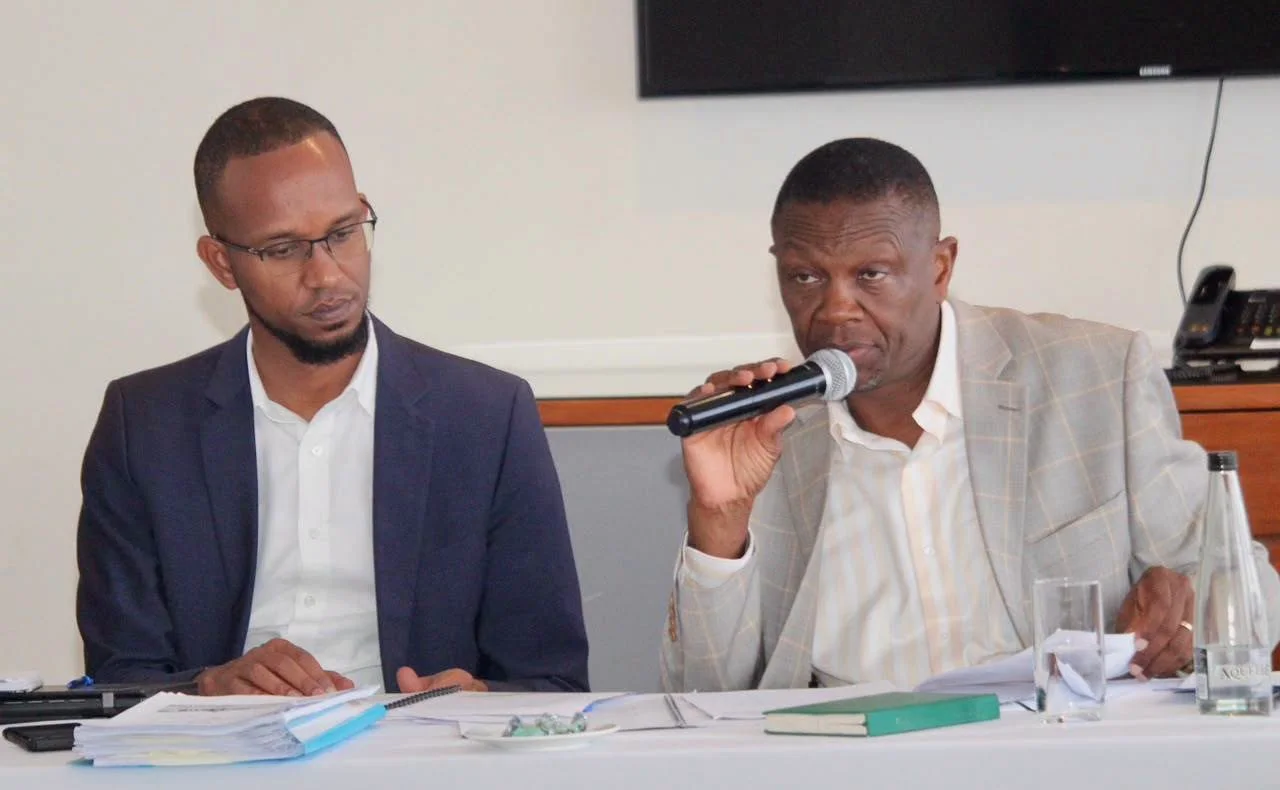
Members of the National Assembly have raised concerns over fish safety, inadequate deep-sea fishing capacity and weaknesses in water infrastructure planning as government agencies responded to audit findings on the water and fisheries sectors.
The concerns emerged when the National Assembly Committee on Blue Economy, Water and Irrigation met various stakeholders on Friday in Machakos County to examine performance audit reports by the Office of the Auditor-General (OAG).
During the session chaired by Marwa Kitayama (Kuria East), Principal Secretary for the State Department for Blue Economy and Fisheries, Betsy Njagi, attributed the limited exploitation of deep-sea fishing resources, which has contributed to low fish production against growing national demand, to a shortage of skilled personnel.
The PS told the Committee that the Government launched a programme in 2019 to train 1,000 Kenyan fishing crew members in practical deep-sea fishing skills.
“Since the Audit, the State Department has developed and gazetted the Fisheries (Marine) Regualtions, 2024, which set standards for access to and sustainable use of marine fisheries resources. This has resulted to marine production rising to 63,636 tonnes in 2025 and increase of about 155 per cent over 2022,” she said.
The audit further identified shortcomings in fish handling and preservation, including failure by Beach Management Units (BMUs) to observe hygiene and sanitation requirements, fishing vessels operating without cooler boxes and ice, inadequate sensitisation of fishers on proper fish handling and insufficient infrastructure at landing sites.
Responding to the findings, Njagi said the State Department, in partnership with the Kenya Marine Fisheries and Socio-Economic Development (KEMFSED) Project, the Aquaculture Business Development Programme (ABDP) and Jumuiya ya Kaunti za Pwani (JKP), had installed post-harvest equipment at various landing sites.
The interventions include drying racks, cold-chain facilities, improved smoking kilns and solar-powered cooling and drying systems.
However, MP Joyce Bensuda questioned the safety of fish consumed in the country, citing concerns raised by fish farmers over unexplained fish deaths in aquaculture cages.
She sought to know whether the State Department had established the causes of the deaths and what measures were in place to guarantee the safety of fish supplied to consumers.
“You have also mentioned the ISO certified laboratories; what is the distribution of them across the Lake regions counties? In Homa Bay, do we have one, where is it? And if not, why don’t we have one?” she asked.
The Committee also received submissions from the State Department for Water and Sanitation on the construction of small dams and water pans, with Engineer Sao Alima appearing on behalf of the Principal Secretary.
The Auditor-General had established that project targets had not been set at agency and regional levels, while the criteria used to select projects and allocate funds to implementing agencies had not been documented.
In her response, Alima said requests submitted by communities and their leaders remained an important mechanism for identifying water infrastructure needs.
She explained that such requests were prioritised based on water demand, previous investments in the areas, available water reserves and the budget allocated for the projects.
Other agencies that appeared before the Committee included the Water Services Regulatory Board and the Water Resources Authority.