CS Chirchir defends Sh70 billion road fund split plan before senators
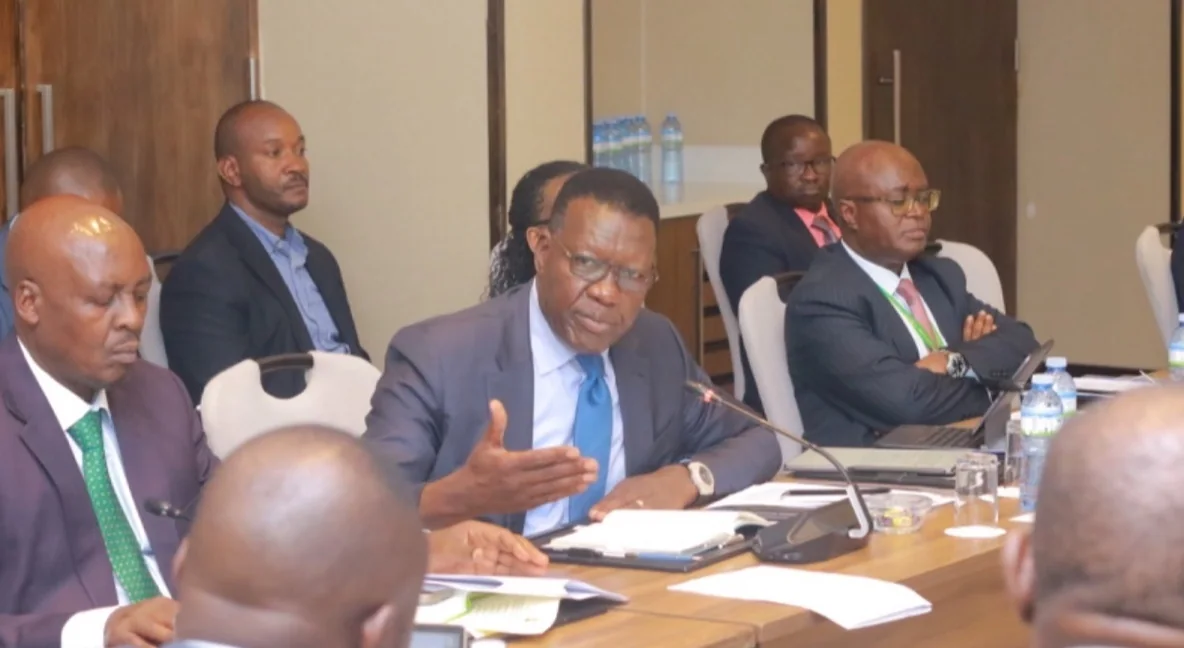
Ministry of Roads and Transport CS Davis Chirchir told the Senate that a proposed Road Maintenance Levy Fund formula would allocate 84.98% to national trunk roads and 15.02% to county roads, with ring-fenced county accounts.
A new proposal by the Ministry of Roads and Transport is seeking to change how fuel levy money collected through the Road Maintenance Levy Fund is shared, with county governments set to officially receive a fixed share even as national roads continue to take the biggest portion of the funding.
Appearing before the Senate Committee on Roads, Transportation and Housing chaired by Migori Senator Eddy Oketch, Roads and Transport Cabinet Secretary Davis Chirchir told lawmakers that the proposal is meant to bring the fund in line with the Constitution and recent court decisions.
Chirchir told the Senators that, “The Ministry recommends that County Governments be expressly recognised as beneficiaries of the RMLF.”
Under the proposed arrangement, 84.98 percent of the Road Maintenance Levy Fund would go to National Trunk Roads while 15.02 percent would be directed to county governments. Based on an estimated Sh70 billion collection, national roads would receive Sh59.49 billion while counties would get Sh10.51 billion.
The Ministry explained that the framework was developed after a High Court decision delivered on June 5, 2025, in the case of Issa Elanyi Chemao and Others v. National Assembly and Others, which questioned how road classifications are used in distributing the levy and whether the current structure is lawful.
Chirchir told the committee that the Constitution is clear on how road functions are shared between the two levels of government.
“The Constitution recognises two categories of public roads National Trunk roads (Class S, A, B and C) and County Roads (Class D, E, F and G) and assigns each to a distinct level of government under Article 186 read with the Fourth Schedule,” Chirchirstates.
The Ministry also presented data showing that county roads make up about 76 percent of Kenya’s road network by length, but only 21 percent of paved roads, while national trunk roads, though fewer in length, carry most of the traffic and support regional trade routes.
To guide the proposed distribution, the Ministry introduced what it called a “scientific, two-tier allocation formula” that takes into account road length, traffic volumes, road condition, and road network type.
Traffic volume was given the highest weight at 45 percent, with the Ministry stating that “traffic intensity is the strongest predictor of pavement wear and the strongest driver of economic return on maintenance.”
Road network type and road length each carry 25 percent weight, while road condition was assigned 5 percent.
Explaining the county share, Chirchir said, “The recommended County share of 15.02percent is the output of the formula and is based on engineering economics county roads are predominantly Class D–G, with low traffic intensity, and a 15 percent share matches the maintenance economics of these classes when weighted by condition and traffic.”
He further noted that the proposal is designed to balance constitutional obligations while ensuring national infrastructure is not underfunded.
Chirchir said, “the allocation recognises County Governments as substantive beneficiaries of the RMLF in line with paragraph 5(a) of Part 2 of the Fourth Schedule, while preserving the resources required for the National Trunk network.”
To strengthen accountability, the Ministry has also proposed strict controls on how county funds will be used.
“RMLF allocations to County Governments must therefore be paid into a dedicated, ring-fenced county roads maintenance account, separate from the County Revenue Fund, and applied solely to the maintenance, rehabilitation and development of county roads,” the document states.
On oversight, the Cabinet Secretary noted that the Kenya Roads Board has legal powers to monitor use of the funds.
He said Section 6(2)(g) of the Kenya Roads Board Act allows the Board to carry out “technical, financial and performance audits” on all projects financed through the levy.




Comments
Sign in with Google to comment, reply, and like comments.
Continue with Google