
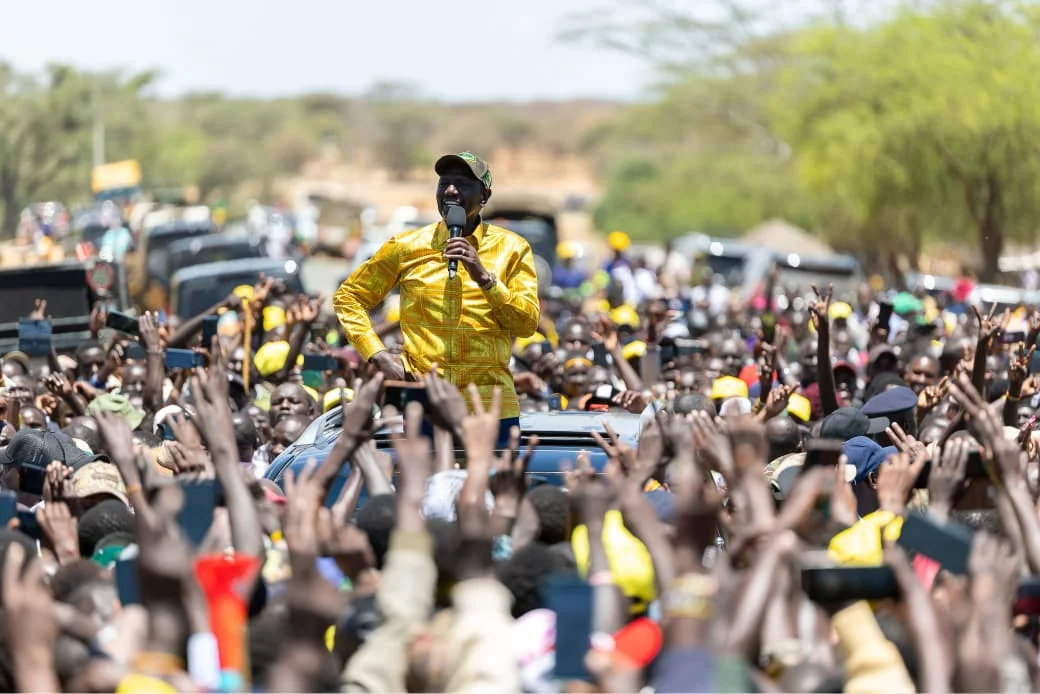
President William Ruto has dismissed claims that live streaming of election results has been banned in Kenya, accusing political leaders of spreading propaganda as debate over electoral transparency intensifies ahead of the 2027 General Election.
Speaking during a church service at AIC Kasina in Mwingi, Kitui County, on Sunday, Ruto said Kenyans had a right to access election results as quickly as possible.
“The sooner Kenyans get to know the results of an election, the better for our nation,” he said.
The President questioned why anyone would try to prevent the real-time transmission of results, calling reports of a ban misinformation meant to mislead the public.
“I have seen them again. They want to start to create another propaganda around the election laws that live streaming has been banned. Nonsense. You know, propaganda, useless, fake news. Why would anybody want to stop live streaming of results? Results are a right of Kenyans,” he said.
His remarks follow a heated debate over the Elections (Amendment) (No. 2) Bill, 2024, which proposes changes to the legal framework governing the determination, transmission and declaration of election results.
The dispute centres on Section 39 of the Elections Act, which requires the Independent Electoral and Boundaries Commission (IEBC) to establish a mechanism for livestreaming results announced at polling stations.
The controversy intensified after Parliament considered amendments that initially appeared to remove the explicit requirement.
The National Assembly subsequently said it had deleted Clause 22, which proposed replacing Section 39, thereby retaining the existing livestreaming provision. Majority Leader Kimani Ichung’wah also rejected claims that Parliament had removed the requirement, saying the law remained unchanged.
Government Spokesperson Charles Owino sought to reassure Kenyans on Saturday, saying results announced at polling stations would continue to be livestreamed.
“Nobody should be worried about live streaming if it’s intact. From our lessons, it will go out. We want to be as transparent as possible,” Owino said.
The IEBC had also dismissed claims of a planned ban in July. Commission chairman Erastus Edung Ethekon said the electoral body had neither decided to stop live streaming nor proposed measures to Parliament aimed at preventing media coverage of electoral processes.
The controversy has drawn criticism from opposition figures and other public leaders. People's Liberation Party leader Martha Karua questioned the implications of the proposed changes, saying the reported removal of the livestreaming requirement was “a sign of fear”.
Former Attorney-General Justin Muturi has also defended livestreaming, arguing that it strengthens transparency, public confidence and citizens' ability to scrutinise the electoral process. Former Law Society of Kenya president Faith Odhiambo also called for clarity on the final wording of the Bill, stressing that electronic transmission and online publication of results forms are not the same as allowing citizens to watch results being announced.
Ruto linked the debate to what he described as a wider problem of political misinformation, urging leaders to stop misleading young people and focus on issues affecting their livelihoods.
“The young people of Kenya want education, they want jobs, they want opportunity, they want to do business, and that is what we are trying to do, to try and harness the talent, energy and knowledge of the young people of our nation,” he said.
The dispute comes as political leaders and institutions position themselves ahead of the 2027 polls, when public confidence in the management and communication of results is likely to remain a major issue.