How FKF CEO’s court battle over affidavit could reshape federation leadership

Football Kenya Federation CEO Harold Ndege has moved to nullify President Hussein Mohammed’s affidavit, escalating an internal leadership dispute into a legal battle that could decide his future at Kandanda House.
The tug-of-war at the Football Kenya Federation has intensified into a courtroom drama. Harold Ndege, the federation’s embattled chief executive, has launched a legal assault on an affidavit sworn by Hussein Mohammed, asking the court to declare the document void as part of his challenge to moves to remove him from office.
Legal challenge and grounds for nullity
Through his lawyers, Ndege argues the affidavit is procedurally defective, claiming it was sworn while Mohammed was reportedly out of the country attending the Africa Cup of Nations in Morocco.
The application presses a technical but potent point: under the Oaths and Statutory Declarations Act, an affidavit must be properly commissioned by the deponent.
Ndege’s team insists that, if Mohammed was absent when the document was sworn, the affidavit is a nullity in law.
In a dramatic escalation, Ndege has asked the court to compel Mohammed to produce his original passport and immigration movement records for January, seeking to prove the president’s whereabouts at the time the affidavit was executed.
Accusations and internal fallout
The court filing is the latest chapter in a bitter and increasingly public rift at Kandanda House. Insiders say Mohammed has lost confidence in Ndege’s stewardship, privately questioning his competence to run the federation’s secretariat.
In a formal letter to Ndege, FKF listed a string of alleged failures: responsibility for the Under-17 team’s poor showing at the CECAFA Championships in Ethiopia, blamed on inadequate preparation and weak structures; failure to inform or consult the president over a Parliamentary summons dated 28 October, 2025; and mishandling of litigation involving Nyamira and Homa Bay, which the federation says exposed it to legal and reputational risk.
The letter also accused Ndege of persistent absenteeism, routinely working from home without authorization, and the controversial practice of signing federation cheques from his residence, a move FKF claims undermined internal controls and accountability.
Meetings, court orders and public drama
Tensions spilt into the open earlier this month when a National Executive Committee meeting on 15 January, chaired by vice president MacDonald Mariga, failed to reach a resolution on Ndege’s fate.
The CEO had already secured court orders from the Employment and Labour Relations Court preventing FKF from discussing or disciplining him at that NEC session.
The dispute turned uglier last week after Ndege posted on Facebook, alleging he had been attacked by unknown assailants at Kandanda House, an incident that ratcheted up the stakes and public scrutiny surrounding the feud.
What comes next
The clash between legal technicalities and political maneuvering now heads to the courts, where procedural questions about the affidavit could determine the fate of the CEO and reshape leadership at FKF.
With accusations flying and trust frayed, the federation faces a turbulent period as it tries to reconcile internal divisions while keeping the business of Kenyan football on track.
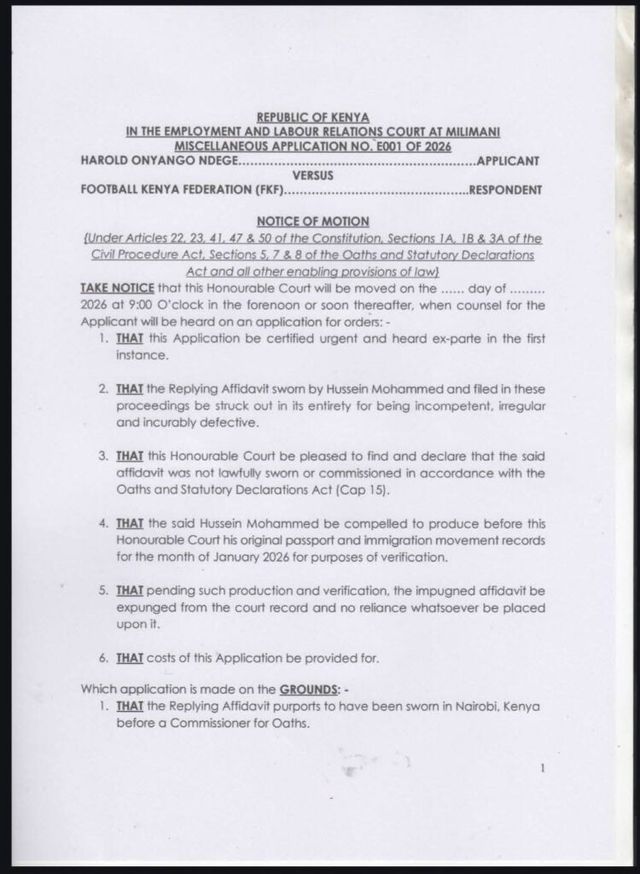 The replying affidavit by Harold Ndege. PHOTO/Handout
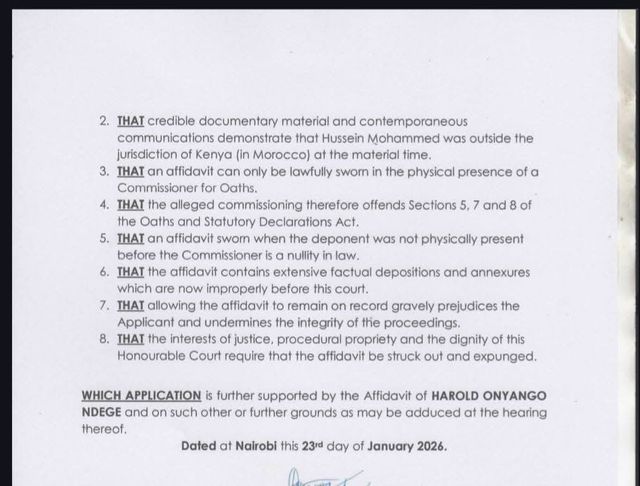 The replying affidavit by Harold Ndege. PHOTO/Handout




Comments
Sign in with Google to comment, reply, and like comments.
Continue with Google