
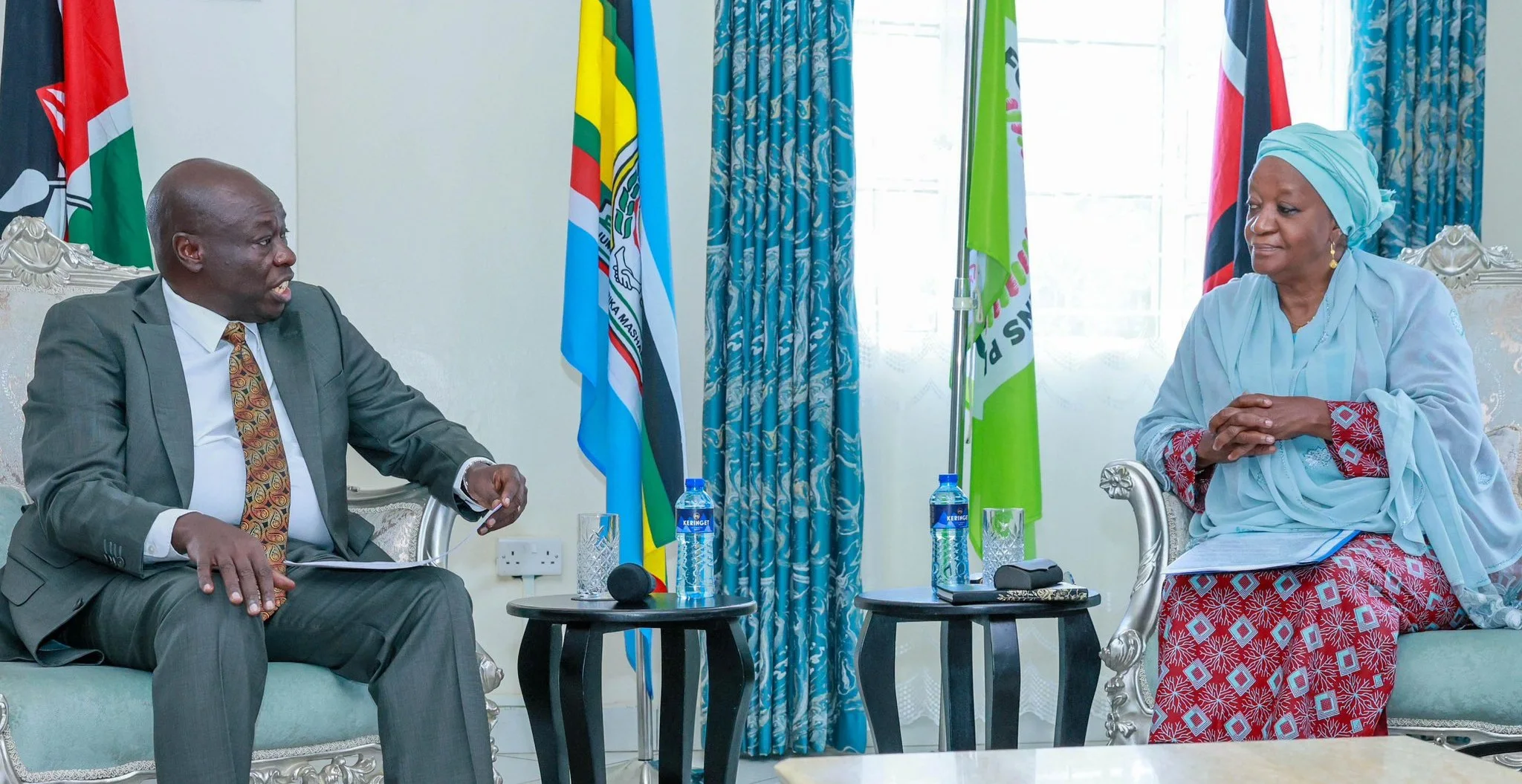
The United Nations has clarified the purpose of its engagement with former Deputy President Rigathi Gachagua, distancing itself from his subsequent political remarks and insisting the meeting was intended to encourage responsible leadership, discourage ethnic incitement and promote national cohesion ahead of the 2027 General Election.
In a statement issued on November 23, 2026, the United Nations Office at Nairobi (UNON) said Director-General Zainab Bangura met Gachagua in his capacity as a former Deputy President, rather than as part of a formal political consultation or engagement with any political formation.
The clarification came after Gachagua made political statements following the meeting, prompting the UN to clarify that the engagement should not be interpreted as support for his political activities or positions.
"UNON wishes to clarify that the engagement was not a formal political consultation or an endorsement of any political formation. Ms. Bangura met Hon. Gachagua in his individual capacity as a former Deputy President of the Republic of Kenya," the statement read.
The organisation said Bangura's decision to engage the former Deputy President was informed partly by her experiences growing up in Sierra Leone, which endured a devastating civil war, and her understanding of the dangers of ethnic divisions, political intolerance and violence.
During the meeting, Bangura appealed to Gachagua to exercise responsible leadership, discourage ethnic incitement and promote national cohesion as Kenya prepares for the next General Election.
" Hailing from Sierra Leone, a country that endured a devastating civil war, Ms. Bangura understands the consequences of ethnic divisions, political intolerance and violence. Her engagement was informed by these experiences and a personal appeal to the former Deputy President to exercise responsible leadership, discourage ethnic incitement and promote national cohesion ahead of Kenya's 2027 General Elections," the statement added.
The intervention comes as political activity gathers momentum ahead of the August 2027 elections, with leaders increasingly positioning themselves and mobilising support across the country.
Gachagua served as Deputy President under President William Ruto from 2022 until his removal through impeachment in October 2024, following a fallout with the Head of State.
He was accused of several offences, including undermining the government, promoting ethnic divisions and conduct deemed inconsistent with the responsibilities of his office. The Senate upheld five of the 11 charges against him, making him the first sitting Deputy President in Kenya to be removed through impeachment.
Since leaving office, Gachagua has emerged as a vocal critic of the Kenya Kwanza administration, regularly challenging its policies, governance record and handling of national affairs.
He has also intensified political mobilisation, particularly in the Mount Kenya region, seeking to rally support around an alternative political movement while raising concerns over governance, accountability, community representation in government appointments and resource allocation.
His remarks have, however, drawn criticism and scrutiny over accusations of ethnic mobilisation, with critics warning that some of his statements could deepen divisions among communities.
The UN also distanced itself from Gachagua's subsequent comments on Kenya's electoral institutions, governance and political environment, saying they were not made on its behalf.
"The United Nations further clarifies that political statements subsequently made by Hon. Gachagua, including those concerning Kenya's electoral institutions, governance and political environment, represent his own views and should not be construed as positions endorsed by the organisation," the statement said.
The organisation said its engagements with political leaders are aimed at encouraging peaceful dialogue, responsible leadership and stability, rather than advancing partisan interests.
With Kenya heading towards the August 2027 General Election, the UN has continued to stress the importance of peaceful polls, respect for democratic institutions and national cohesion, amid concerns over the country's history of election-related tensions and violence.