
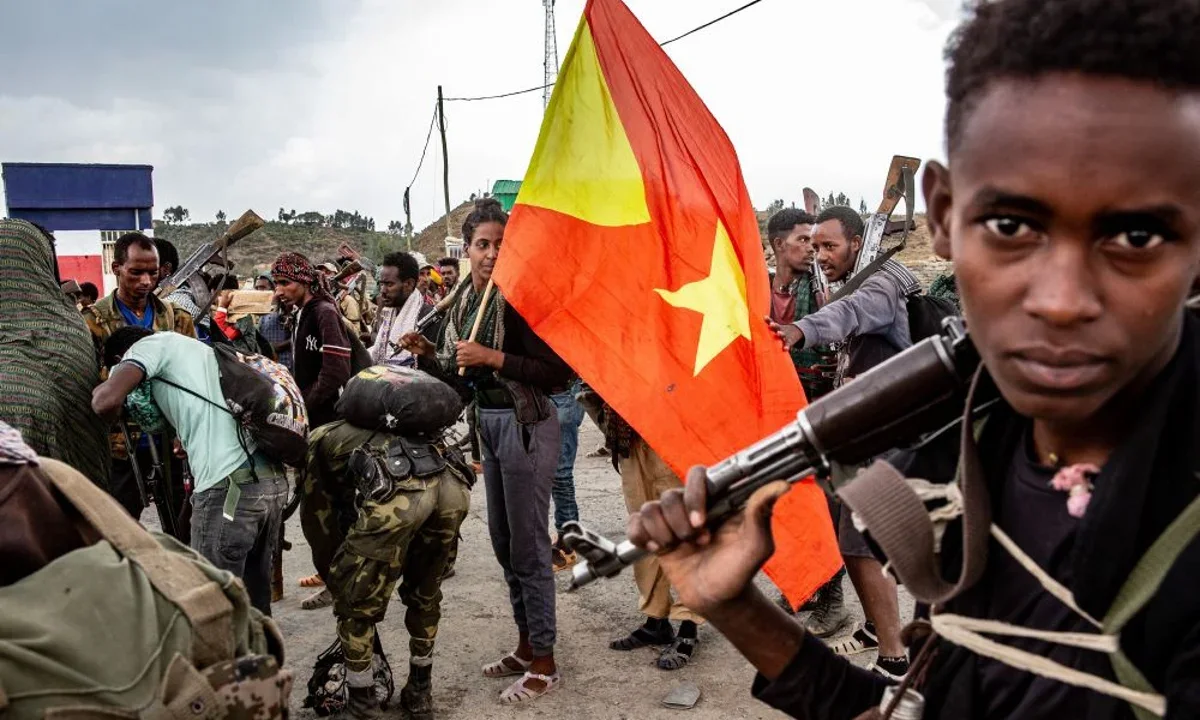
The deaths of at least 14 civilians in a three-day artillery assault on a densely populated Ethiopian city have prompted Amnesty International to demand an independent investigation into possible war crimes involving government troops and their allied forces.
The rights watchdog said civilians in Alamata, in the Tigray region, were caught in repeated artillery attacks between September 26 and 28, with residential homes, neighbourhoods and a commercial establishment among the areas struck.
In a report published on Tuesday, Amnesty said it had verified 14 civilian fatalities in four separate incidents, while several other people suffered injuries during the bombardment of the strategic city, which has an estimated population of 80,000.
The organisation accused the Ethiopian National Defence Forces (ENDF) and their allied Tigray Peace Forces (TPF) of carrying out repeated strikes without adequately considering the danger posed to residents.
“For three consecutive days, the ENDF and TPF repeatedly shelled Alamata in total disregard of the lives of its 80,000 inhabitants,” said Yasmine Ahmed, Amnesty International’s Senior Director for Regional Human Rights Impact.
“The use of artillery, a weapon with wide-area effects, in densely populated neighbourhoods has a terrible impact on civilians. Indiscriminate attacks violate the rules of international humanitarian law, and these strikes must be investigated as war crimes,” she added.
Amnesty's investigation documented several incidents in which civilians were killed inside their homes and while going about their daily activities.
One of the most devastating attacks claimed the lives of 26-year-old Meron Sewasew, her eight-year-old son and her 33-year-old brother after artillery struck their residence in the condominium section of Kebele 04 on September 27.
Sewasew, who was a mother of two, lost her life alongside the two family members, while her two-year-old son survived with minor injuries.
Her husband recounted the incident to Amnesty investigators, providing details of the attack and the fate of the surviving child.
A day earlier, on September 26, another artillery strike hit Nigus Shimoy, a bar located near a busy market, at approximately 11:00am.
The attack killed at least three people who had gathered at the establishment to mark Demera, a traditional celebration held on the eve of the Ethiopian Orthodox Meskel holiday.
In a separate incident on September 27, 55-year-old Deyima Rebso was killed when artillery struck her home in Kebele 02. Her husband, children and grandchild sustained serious injuries in the same attack.
To establish the circumstances surrounding the bombardment, Amnesty interviewed 28 individuals, including people who survived the strikes, eyewitnesses, families of victims, healthcare workers and humanitarian staff.
The organisation also reviewed video recordings, photographs and satellite imagery to support its findings and reconstruct the attacks.
Its investigation further pointed to Waja Ena Tumuga, an area situated approximately 13 kilometres south of Alamata, as the main position from which Ethiopian government troops and their allied forces launched artillery towards the city.
However, the report also examined the activities of fighters affiliated with the Tigray People's Liberation Front (TPLF), raising concerns about their alleged use of civilian facilities for military purposes.
Amnesty said TPLF-affiliated forces had established military positions in residential neighbourhoods, including several schools, before the fighting resumed.
Witnesses interviewed by the organisation alleged that TPLF fighters used some schools as military bases and, in certain instances, fired artillery from within civilian neighbourhoods.
The rights organisation warned that such deployments exposed residents to danger but insisted that they could not be used as justification for indiscriminate attacks by the opposing forces.
“Any possible violation of international humanitarian law by TPLF through placing their forces and military objects inside densely populated neighbourhoods does not absolve the ENDF and its allies of their obligations and can never justify the indiscriminate use of explosive weapons, such as artillery, in a densely populated area,” Ahmed said.
The TPLF disputed the allegations against its fighters in a letter submitted to Amnesty on November 18, dismissing them as unfounded and demanding a more detailed independent inquiry before any conclusions were reached.
"While the preliminary findings acknowledge certain atrocities committed by the Ethiopian Federal Government and its forces, we are deeply concerned by the allegations directed against the Tigray Security Forces [TPLF]. We categorically reject these allegations as unfounded and believe that they require further independent, impartial, and comprehensive investigation before any conclusions are drawn regarding responsibility," the TPLF said in its report.
The Ethiopian National Defence Forces and Tigray Peace Forces had not issued responses to the findings by the time of publication, although Amnesty said it had reached out to them for comment.
Following the findings, Amnesty appealed to the United Nations Human Rights Council to establish an independent investigative body with powers to examine violations, identify suspected perpetrators and pursue accountability for crimes under international law.
Ahmed said the continued failure to punish those responsible for serious violations had allowed abuses to persist, warning that the situation required urgent international intervention.
"Impunity has emboldened perpetrators to carry on committing serious violations with no fear of the consequences. This must end. The UN Human Rights Council must act fast to establish an independent mechanism to investigate, identify those responsible for crimes under international law, and ensure they are held accountable,” said Ms Ahmed.
Amnesty also called on the Ethiopian government to allow human rights investigators, members of the media and humanitarian agencies unrestricted entry into conflict-affected areas.
The organisation said access was necessary to enable independent monitoring, document alleged abuses and ensure that the situation facing civilians in affected communities receives proper attention.