
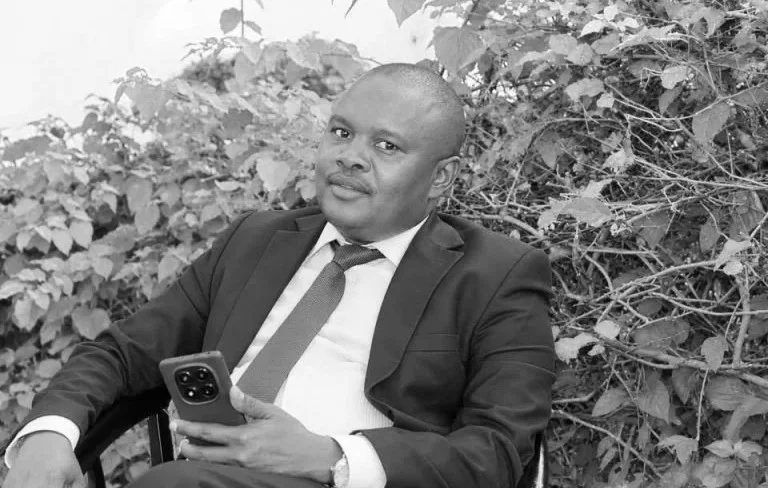
The death of former journalist Kitavi Mutua following a snakebite has brought renewed attention to the controversial religious movement known as Kavonokya, whose followers are reported to reject conventional medical treatment and rely entirely on prayer for healing.
Mutua died on Friday, October 30, 2026, after suffering complications from a bite by a red spitting cobra at his home in Kitui South.
His death has sparked outrage among relatives, who allege that his access to medical attention was delayed because of his family's religious convictions.
According to accounts shared by his relatives on social media, Mutua remained at home for an extended period after the snakebite as his family relied on prayers instead of seeking immediate medical treatment.
He was eventually taken to hospital after his condition had deteriorated.
His cousin, gospel singer Faith Kithele, has spoken out about the circumstances surrounding his death, alleging that his father initially relied on prayers in the belief that divine intervention would heal his son.
In another emotional social media post, his cousin Cyrus Kithele directly blamed the religious movement for the tragedy, declaring, "The snake bite didn't kill Kitavi. Kavonokya did!"
Cyrus further alleged that Mutua was kept at home for three weeks following the snakebite, claiming that the family concealed his condition from people outside their religious circle until someone eventually intervened to take him to hospital.
He also disclosed that the family had previously lost three children on the same day and later their mother to medical conditions he believes could have been treated through conventional medicine.
Cyrus has consequently called for government intervention, arguing that religious movements whose teachings endanger human life should be thoroughly investigated and held accountable.
He questioned why neighbours, local leaders and other relatives who may have known about the situation did not intervene to ensure Mutua received medical attention in time.
The tragedy has turned the spotlight on Kavonokya, also known as Arata Aroho Mutheru, an indigenous Christian religious movement with a presence in Kitui, Tharaka-Nithi, Embu and Meru counties.
The movement traces its origins to the 1950s, when African Christians sought to establish an indigenous form of worship independent of missionary-controlled churches. Its name is associated with the Kamba word kuvonoka, meaning to awaken or recover.
Its headquarters is reported to be in Irundini village in Tharaka-Nithi County.
The movement was led by Gitonga M'Mupunguru until his death in September 2020.
At the centre of Kavonokya's teachings is a strong belief in divine healing, with prayer considered the primary response to sickness and physical ailments.
Followers are reported to reject modern medicine, hospital admissions, prescription drugs and childhood vaccinations.
Pregnant women are also said to avoid antenatal clinics and opt for home deliveries, while some parents reportedly hide their children when public health officers visit to administer vaccines against diseases such as polio, measles and tuberculosis.
The movement's beliefs reportedly extend beyond healthcare to education and participation in government activities. Some followers avoid obtaining national identity cards, participating in population censuses and voting, arguing that these are earthly activities that conflict with their religious convictions.
Their worship practices are equally distinctive. Rather than gathering in conventional church buildings, members often worship under trees or in simple shelters, believing that God's presence cannot be confined within four walls.
Their services feature traditional drums, singing, rhythmic jumping and stamping of feet during prayers.
Women are commonly associated with strict dress codes, including head coverings and long dresses extending to the ankles, in keeping with the movement's emphasis on modesty.
The controversy surrounding Kavonokya has drawn comparisons with the Shakahola religious cult led by controversial preacher Paul Mackenzie, where hundreds of people died following extreme teachings that encouraged followers to fast in anticipation of meeting Jesus.
Although the two movements have different teachings and practices, concerns have emerged over similarities in the way religious authority and extreme spiritual convictions can influence followers' decisions about their lives.
In Shakahola, followers were reportedly subjected to extreme fasting and discouraged from abandoning the practice, even as their health deteriorated.
In the case of Kavonokya, the concerns centre on the reported rejection of medical treatment and reliance on prayer even in life-threatening situations.
Both cases raise questions about the vulnerability of followers, the influence of religious leaders, the protection of children and the responsibility of authorities to intervene when religious practices threaten human life.
However, the two movements should not be treated as identical.
While the Shakahola tragedy involved mass deaths linked to extreme fasting, allegations against Kavonokya largely concern denial or delayed access to conventional medical care.
Kenya's Constitution guarantees freedom of religion and belief under Article 32.
However, this right exists alongside the right to life, healthcare and protection of children from neglect and harmful practices.
The government therefore faces the delicate task of protecting religious freedom while ensuring that no individual is denied essential medical attention because of religious teachings.
Kitavi Mutua's death has once again reopened the national conversation about religious extremism, medical neglect and the regulation of religious institutions.
With the country still grappling with the lessons of Shakahola, the question is whether authorities will move beyond investigations after lives have been lost and take preventive action against practices that place vulnerable members of society at risk.