
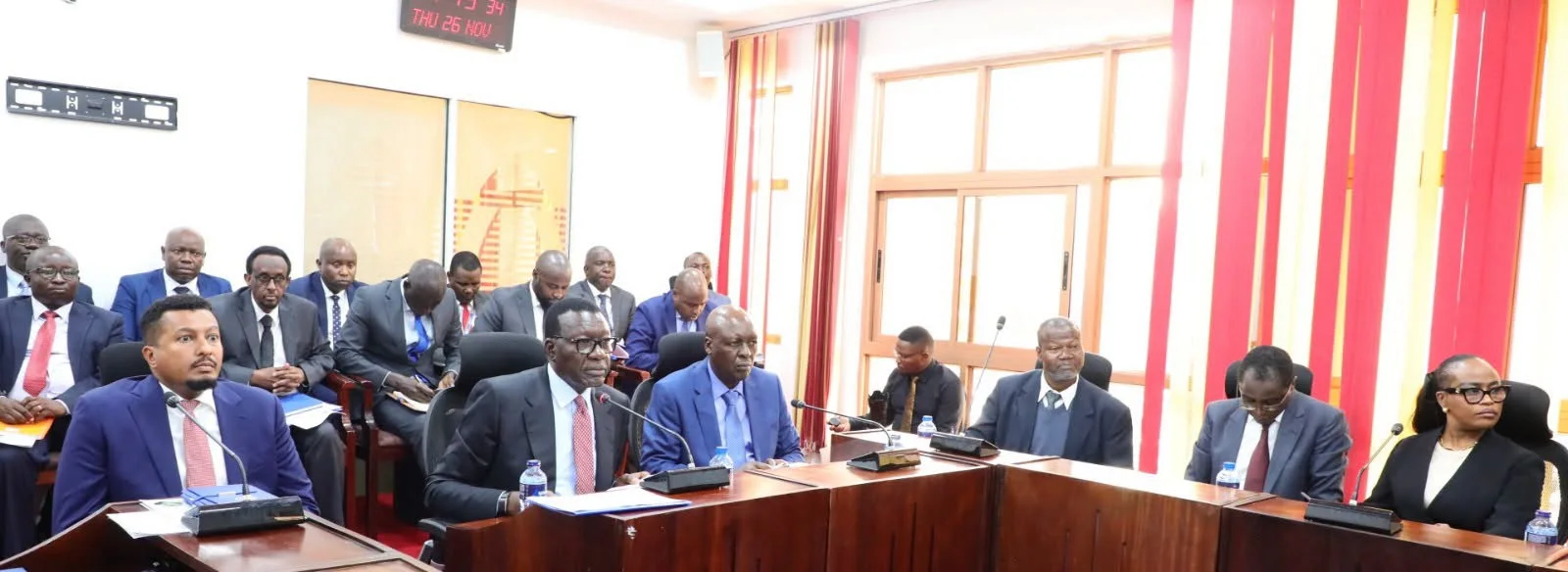
Kenya’s transport sector faces a Sh31.9 billion funding shortfall in the proposed 2027/28 budget, as senators demand transparency over public-private partnership (PPP) projects and risks to taxpayers.
The State Department for Transport told the Senate Standing Committee on Roads, Transportation and Housing that it required Sh101.985 billion for recurrent and development programs but had been allocated Sh70.059 billion, leaving a deficit of Sh31.926 billion.
In a submission presented by Principal Secretary Mohamed Daghar, the department said development spending accounted for Sh30.811 billion of the gap, while recurrent expenditure faced a Sh1.115 billion shortfall.
The Lamu Port-South Sudan-Ethiopia Transport Corridor resilience program has a Sh8.05 billion deficit, while the Dongo Kundu Special Economic Zone faces a Sh9.48 billion shortfall.
“This translates to absorption of 32% and 18% for recurrent and development, respectively. Table 1 shows the FY 2026/27 expenditure and absorption levels as at 31st October 2026,” the submission states.
Senators also pressed Roads Cabinet Secretary Davis Chirchir to explain how the government monitors revenue, traffic and profitability under concession agreements, particularly the Nairobi Expressway.
Kitui Senator Enoch Wambua said vehicle counts alone were insufficient and demanded access to the operator’s accounts.
“Traffic figures alone are not enough. What is the level of visibility by government, by your Ministry, on the entire operations of the Expressway? We need to know the traffic, the accounts and the revenue collected so that investors do not simply declare losses and walk away, leaving the government to deal with the consequences,” said the Kitui Senator.
Migori Senator Eddy Oketch questioned whether agreements protected taxpayers from liabilities falling on the Exchequer.
“Are there provisions in the concession agreements covering contingent liabilities that could arise and require the Exchequer to intervene? Parliament needs to understand what happens when those obligations materialise,” Senator Oketch said.
Nominated Senator Peris Tobiko asked who would bear the risk if projected traffic failed to materialise.
Chirchir said investors carried that risk and denied the agreements created contingent liabilities for government.
“The traffic risk is borne by the investor. We don't have any contingent liability that would in any way accrue to the government,” he said.
He urged senators to allow a detailed briefing.
"Allow us to basically make a substantive presentation to Parliament on how we protect the Government and how investors protect themselves, because it's a win-win," he said.
Chirchir warned against toll charges that could raise the cost of moving goods.
"Don't forget that if we build Nairobi-Mombasa to Malaba, and you are being charged Sh100,000 to move cargo on that road, that pricing will be loaded into the goods. It makes the country totally unattractive," he said.
The department warned funding constraints could delay projects and undermine expected benefits.