
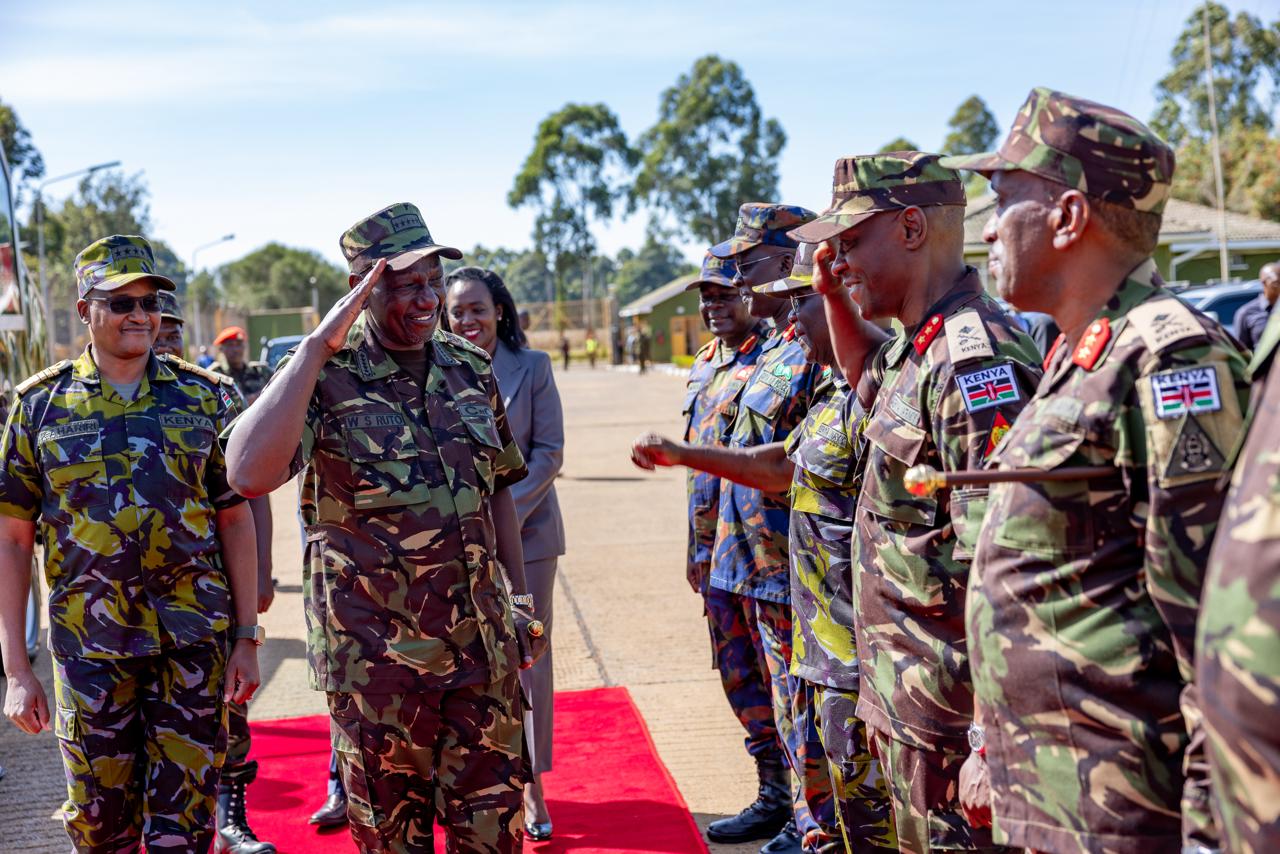
A recent opinion piece by veteran columnist Macharia Gaitho, in which he described Kenya's security agencies as a "criminal enterprise", has reignited debate about the conduct of the country's security institutions, particularly following the alleged abduction of lawyer Abshir Abdi.
Gaitho's article raises questions about alleged misconduct within the security sector, an issue that deserves public attention and serious investigation.
However, characterising the country's security agencies collectively as a “criminal enterprise” risks overlooking the broader work undertaken by thousands of officers tasked with protecting Kenyans and safeguarding the country's borders.
The article also brings into focus a growing trend in Kenya, where leaders from both sides of the political divide, legal practitioners and political commentators have increasingly accused the National Intelligence Service (NIS) and police agencies, including the Directorate of Criminal Investigations (DCI) and the Anti-Terrorism Police Unit (ATPU), of involvement in abductions and enforced disappearances.
While individuals are entitled to raise concerns and demand answers, serious allegations against security agencies must be backed by credible evidence.
Blanket accusations without substantiation risk unfairly casting aspersions on officers who carry out their duties professionally and within the law, while undermining public confidence in institutions tasked with protecting the country.
This is not to suggest that security agencies are above criticism or that allegations of misconduct should be brushed aside. Far from it. Where there is evidence of wrongdoing, investigations must follow and those responsible must face the law and that national security should not be politicised.
There are good reasons for this argument.
National security should never become a political weapon in Kenya. It is a constitutional responsibility that transcends political parties, election campaigns and individual administrations. Whether one supports the government or the opposition, the safety of Kenyans should be a shared national priority.
There are several reasons why Kenya must keep national security above partisan politics.
The safety of Kenyans comes first
From banditry in the North Rift to terrorism threats in different parts of the country, cattle rustling, organised crime and insecurity in urban centres, security challenges affect Kenyans regardless of their political affiliations.
When leaders turn these issues into political contests, the focus risks shifting from finding solutions to assigning political blame.
Kenya's experience with terrorism offers a particularly sobering reminder of why the line between politics and national security must remain clear.
The Westgate attack, the Garissa University massacre and the DusitD2 attack demonstrated the devastating consequences of security threats and the importance of coordinated intelligence gathering, inter-agency cooperation and effective security responses.
These are not matters that should be reduced to political talking points.
Security agencies must remain independent and professional
The National Police Service, National Intelligence Service and Kenya Defence Forces have distinct constitutional and legal mandates.
Their loyalty must be to the Constitution and the Republic of Kenya, not to the President, opposition leaders or political parties.
Equally, security agencies should never be used to settle political scores, intimidate opponents or shield individuals from accountability.
The professionalism of security officers is critical to the country's stability. Political leaders must therefore resist the temptation to drag security institutions into partisan disagreements or ethnic rivalries.
Politicisation can undermine public confidence
Kenya has a history of public concerns about police conduct, excessive use of force, arbitrary arrests and accountability.
When security operations are interpreted exclusively through political or ethnic lenses, public confidence in institutions can deteriorate further.
Kenyans deserve security agencies that are trusted, professional and accountable. They also deserve an environment where allegations against officers are investigated without political interference.
The challenge is to strike a balance between protecting the integrity of security institutions and ensuring that those who violate the law are held accountable.
Security should not become an election campaign tool
With the 2027 General Election approaching, security matters could increasingly feature in political messaging.
Leaders must resist the temptation to exploit insecurity, police operations or intelligence reports to mobilise political support.
National security should not become a contest over who appears tougher, who gets blamed or who scores political points.
The country has enough political battles to fight without turning the institutions responsible for protecting its citizens into another political battleground.
Intelligence and security operations require responsibility
Kenya faces security threats that require coordination, confidentiality and cooperation between security agencies and neighbouring countries.
Releasing sensitive operational information or making unsubstantiated allegations for political advantage could compromise investigations and expose operations, intelligence sources and personnel to danger.
Speaking in August at a training camp in Samburu County, where he presided over the graduation of 122 officers from the 11th Special Operations Group (SOG) course, Murkomen urged those engaged in political mobilisation to keep ethnic rhetoric away from security institutions, warning that such divisions could undermine agencies responsible for protecting the country.
“I must tell them to keep off our security. This is national security. We are patriots. We want to protect our nation,” he said.
He added that political spaces should not become platforms for ethnicising the security services.
“Go ye, go away with your ethnic bigotry, which you exercise in political spaces. You must not bring it to the security circles,” he said.
Murkomen is not alone in raising concerns about the politicisation of national security.
In May 2025, NIS Director General Noordin Haji, while appearing before the National Assembly's Departmental Committee on Defence, Intelligence and Foreign Relations at Bunge Tower in Nairobi, urged legislators to prioritise national security.
He warned that external conflicts, including the wars in Ukraine, Gaza and Yemen, were introducing new security challenges for Kenya.
“There is no amount of money that can absolutely ensure Kenya’s safety. It is sad that we do not see the need to appreciate where we are, and we go out politicising everything. We are not going to overcome whatever we are facing,” Haji added.
One only needs to consider the scale of security operations undertaken by Kenya's Special Operations Group (SOG) against insurgents in the Boni Forest in Lamu to appreciate the demanding work carried out by the country's security community, including the NIS, Kenya Defence Forces and National Police Service, in confronting threats posed by militant groups.
These operations require intelligence, coordination, sacrifice and professionalism. They deserve recognition alongside the scrutiny that comes with exercising public authority.
Accountability should not be mistaken for hostility
Kenya has the Independent Policing Oversight Authority (IPOA), an institution established to provide civilian oversight of police conduct, investigate complaints and promote accountability within the National Police Service.
Its work offers an important reminder that misconduct by individual officers does not automatically define every officer or the entire institution.
For instance, IPOA has secured significant outcomes in investigations involving alleged police excesses.
On July 6, 2026, the High Court in Nakuru convicted Police Constable Francis Kiarie on two counts of murder over the 2016 fatal shooting of John Maina and Charles Kariuki.
On July 9, 2026, the High Court also convicted Administration Police Constable Isaac Lekachuma over the 2017 murder of Emmanuel Makokha.
In another development on July 9, 2026, the High Court dismissed an application by police officers James Were and Christopher Thuita seeking to halt their murder prosecution over a fatal shooting during a Nairobi police chase, affirming IPOA's authority to investigate and recommend charges.
IPOA has also made progress in investigations involving bodies recovered from River Yala. In November 2026, the authority reported identifying 10 of the 25 bodies recovered from the river between 2013 and 2025, using DNA samples collected from 82 family members.
The findings were submitted to the Office of the Director of Public Prosecutions (ODPP) and a victim compensation panel.
These cases demonstrate that accountability is possible and that allegations of police misconduct can be subjected to investigation and judicial scrutiny.
The government has also announced a compensation mechanism for victims of protests and public demonstrations dating back to 2017.
During his State of the Nation Address on November 18, 2026, President William Ruto said the government had allocated Sh2 billion for compensation.
He reported that Sh1.2 billion had been disbursed by July 2026 to 1,476 verified beneficiaries, including 1,036 civilians and 356 police officers injured on duty, while acknowledging state wrongdoing where unlawful force occurred.
These developments do not erase the pain of victims or suggest that all cases of misconduct have been resolved. They demonstrate, however, that oversight, investigations, prosecution and compensation are part of the broader national accountability framework.
Kenya needs a national security conversation, not a political shouting match
Ultimately, Kenya's security agencies face an evolving network of threats, from terrorism and organised criminal enterprises to cross-border insecurity and emerging security challenges.
Their constitutional mandate is to protect the country and its people. That responsibility must be respected, just as their obligation to operate within the law must be enforced.
The debate should therefore not be about choosing between defending security agencies and demanding accountability. Both are necessary.
The government must be held accountable when it fails to protect citizens. Security officers who violate the law must face justice. Equally, political leaders and commentators must exercise responsibility when making allegations that could undermine public confidence in critical national institutions.
Kenya needs security agencies that are professional, independent and accountable. It also needs political leaders who understand that national security is bigger than the next election, political survival or the daily exchange of political jabs.
After all, terrorists, organised criminal networks and other threats to our national security do not ask whether a Kenyan is UDA, ODM, DCP or affiliated with any other political formation before striking.
Why, then, should the people tasked with protecting us be dragged into those divisions?
National security is a national responsibility. It should be treated as such.