Ruto pledges Sh142 billion investment to unlock Kenya’s blue economy potential
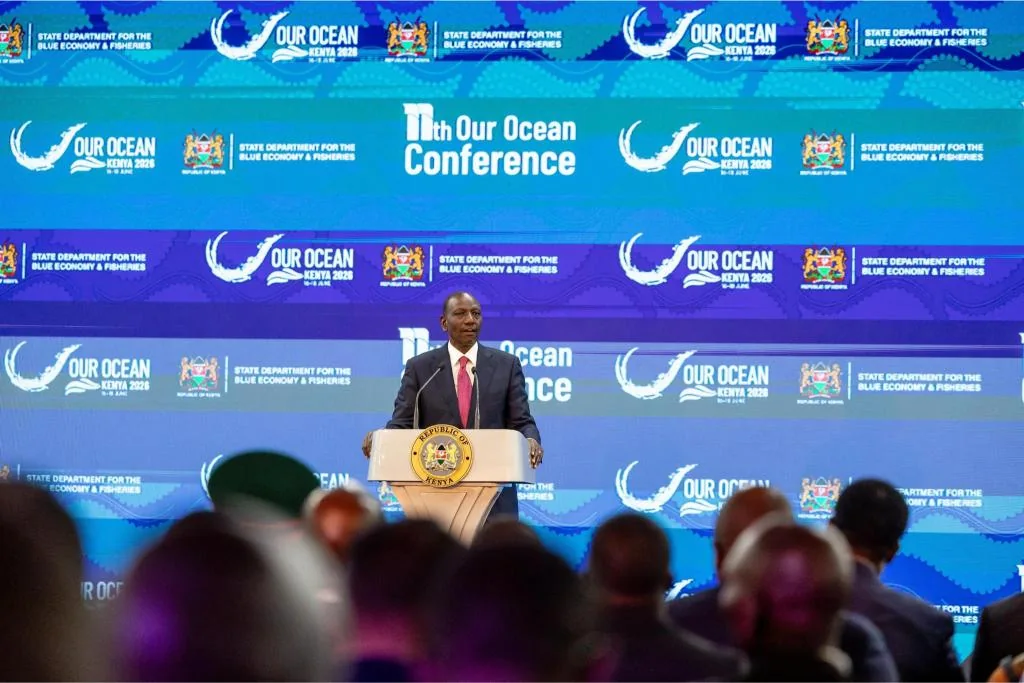
Ruto said the decision to focus on the blue economy was made three years ago after the government identified that the sector had not been contributing enough to national growth and development.
President William Ruto has announced a Sh142 billion investment plan aimed at strengthening Kenya’s blue economy, in what marks a major push to expand fisheries, maritime development and ocean-based economic activities across the country.
He said the government will implement 40 commitments made during the 11th Blue Economy Conference, noting that Kenya is positioning itself to take greater advantage of resources in oceans, lakes and other water bodies.
“Kenya alone has made 40 commitments valued at $1.1 billion in support of our blue economy,” Ruto said, adding that the country is keen to tap opportunities provided by the sector.
Ruto said the decision to focus on the blue economy was made three years ago after the government identified that the sector had not been contributing enough to national growth and development.
“I took the decision that I am going to have a dedicated blue economy and fisheries state department. As a result, in the last three years, we have invested Sh20.3 billion in our blue economy and fisheries ecosystem.”
He explained that key infrastructure projects are already underway, including fish landing sites meant to support fishing communities and improve access to markets.
Ruto said three fish landing sites have already been completed, while five more are being built along the Indian Ocean coast and 10 others at Lake Victoria.
“We have another five under construction at the Indian Ocean coast and 10 in Lake Victoria for a total of 15 fish landing sites that are going on and markets at a cost of Sh2.8 billion.”
He further noted that the Shimoni Fish Port, whose construction began two years ago, has now been completed and the government is seeking an operator to manage it.
“We did break ground for the construction of Shimoni Fish Port two years ago and it is now complete.”
“We are now looking for an operator at a cost of Sh2.6 billion.”
Ruto also highlighted progress in aquaculture development, saying two centres of excellence have been established to support fish farming and research.
The centres, located in Kisumu and Kwale, are in their final stages of completion and were developed at a cost of Sh2.5 billion.
In addition, the government has procured patrol, research and rescue boats worth Sh1.4 billion, which have already been distributed to support coastal and lakeside communities. Community boats have also been provided to improve local livelihoods.
Ruto said 86,000 community members have benefited from government support amounting to Sh3.3 billion, adding that further investment has gone into strengthening maritime information and research systems.
“We have invested another Sh3 billion to a maritime center that will be used for information gathering and research that is going to assist our fishery and blue economy ecosystem,” Ruto said.
He, however, warned that oceans are under increasing pressure from climate change, pollution and overuse, saying the situation is already affecting ecosystems and livelihoods.
“By absorbing 90 per cent of excess heat trapped by greenhouse gases and almost a third of our carbon dioxide emissions, it has quietly altered its own chemistry and physics to shield the rest of us from harm.”
Ruto said rising sea levels are displacing communities in low-lying coastal areas and islands, while changing ocean conditions are weakening marine food chains.
He added that stronger storms, marine heat waves, storm surges and coastal flooding are damaging infrastructure and increasing risks for vulnerable populations.
“Marine pollution, above all plastics, is reaching the deepest trenches and affecting even the smallest fish. For too long, our response has been held back by weak political will, inadequate finance, the slow deployment of technology and innovation, limited capacity and governance that is fragmented, weakly regulated and poorly enforced.”
Despite these challenges, Ruto said innovation and human effort can turn the situation around and unlock new opportunities in the sector.



Comments
Sign in with Google to comment, reply, and like comments.
Continue with Google