
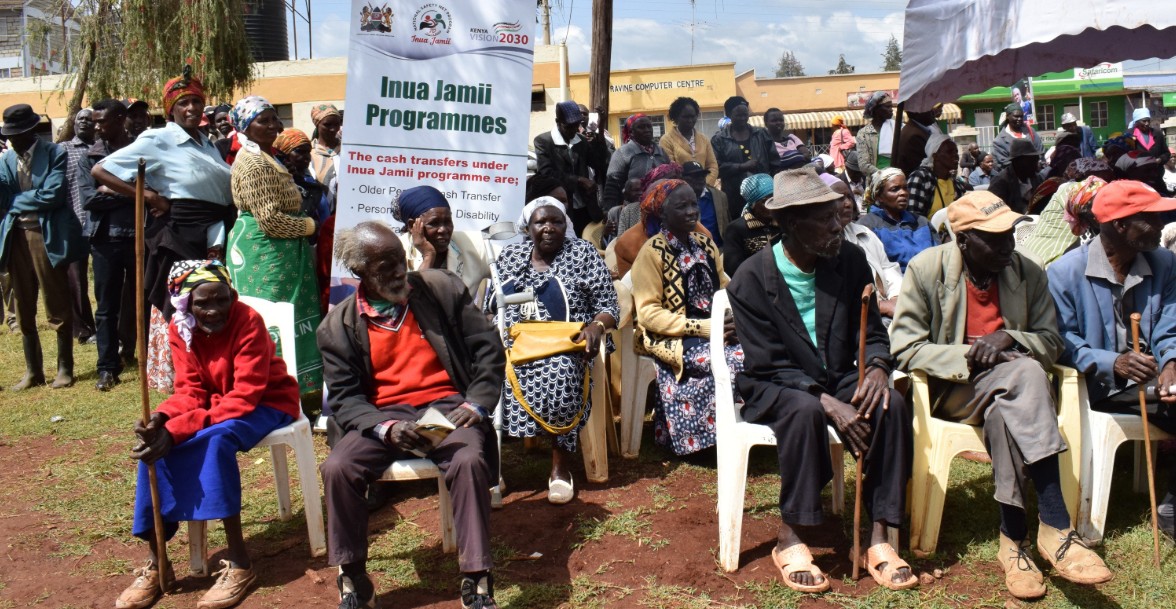
Government programmes offering financial assistance, healthcare and specialised support to vulnerable Kenyans could come under strain after the State Department for Social Protection received less than three-quarters of the funding it needs for the 2027/2028 financial year.
The Sh12.97 billion deficit is expected to affect a range of services, including monthly Inua Jamii payments to the elderly, medical cover for indigent households under the Social Health Authority (SHA) and assistance extended to persons with disabilities.
Principal Secretary Joseph Motari raised the concerns before the National Assembly Departmental Committee on Social Protection, where he presented the department's funding requirements and the allocation it had received for the coming financial year.
The department had requested Sh49.39 billion to finance its programmes but was allocated Sh36.42 billion, leaving it unable to fully meet its planned recurrent and development expenditure.
The recurrent budget accounts for the largest share of the deficit. The department had sought Sh44.97 billion under the Sector Working Group process but received Sh34.41 billion, translating to a Sh10.56 billion shortfall.
Its development budget was also reduced from Sh4.42 billion to Sh2.01 billion, leaving a deficit of about Sh2.40 billion that could affect planned projects and infrastructure investments.
“The Development Budget suffered an even steeper percentage slash, receiving Sh2.01 billion against a requirement of Sh4.42 billion," PS Motari said, adding that “the 45.5 per cent allocation leaves a shortfall of approximately Sh2.40 billion, threatening key capital and infrastructure projects.”
Motari told the committee that despite the country's economic performance being above global and regional averages over the past three years, the social protection sector continued to face financial constraints that could hamper its operations.
He cautioned that the limited funding could undermine the department's ability to fulfil its mandate and contribute to the government's Bottom-Up Economic Transformation Agenda (BETA).
Medical support for indigent households under SHA is among the programmes facing the largest funding deficits, with the department requiring an additional Sh5.51 billion to sustain the cover.
The government has directed the department to enrol another 300,000 indigent people, bringing the total number of beneficiaries expected to receive medical insurance under the Social Health Insurance Fund (SHIF) to 750,000.
“Following a government directive to onboard an additional 300,000 indigent beneficiaries, the Department must cover 750,000 vulnerable citizens under the Social Health Insurance Fund (SHIF) at Sh660 per month," he said.
The department, however, has only Sh430 million available for the initiative, leaving a substantial deficit in the funds needed to provide medical cover to the targeted population.
The Inua Jamii cash transfer programme is also facing a Sh2 billion funding gap, while Adult Learning and Education initiatives require an additional Sh241 million to meet their financial needs.
Disability support programmes have equally been affected, with the National Development Fund for Persons with Disabilities (NDFPWD) reporting a Sh68.66 million deficit.
“The National Development Fund for Persons with Disabilities (NDFPWD) faces a Sh68.66 million gap that threatens ongoing scholarships for 4,700 learners with disabilities, start-up capital and tools of trade for vocational graduates, and assistive devices," the PS said.
The deficit could disrupt financial assistance to 4,700 learners with disabilities, limit access to start-up capital and equipment for vocational training graduates and affect the distribution of assistive devices.
Meanwhile, the Autism and Developmental Disabilities Programme, which caters for more than 17,000 people with autism, cerebral palsy, Down syndrome and epilepsy, has received about half of the money required to provide therapy, essential medication and adult diapers.
The National Assembly Departmental Committee on Social Protection is expected to scrutinise the department's proposed budget and make recommendations on the 2027 Budget Policy Statement before the government finalises budget ceilings.