
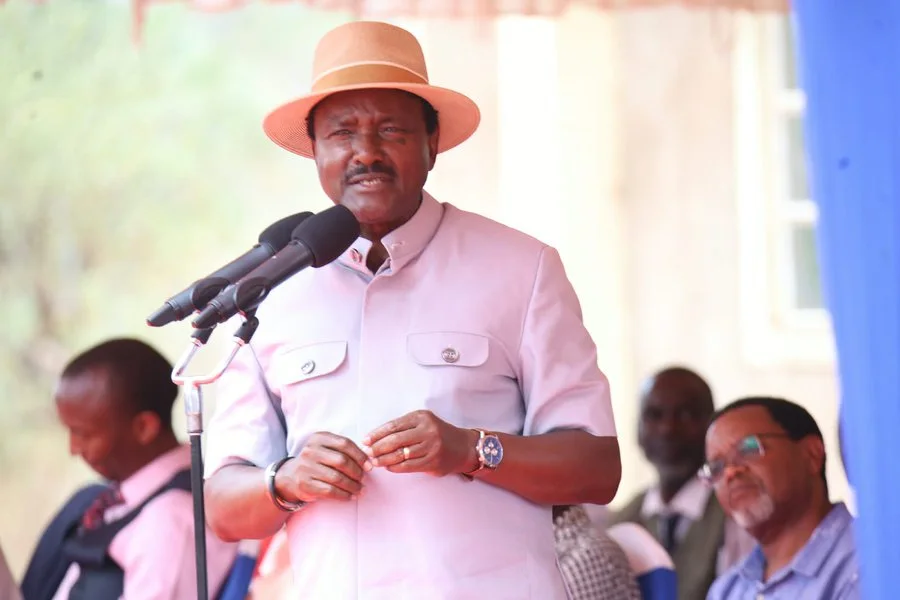
Wiper Party leader Kalonzo Musyoka has pledged to declare June 25 a National Accountability Day if the opposition forms the next government, promising to make the date an annual occasion for remembering victims of state violence and pursuing justice for those killed during demonstrations.
Kalonzo said the proposed commemoration would go beyond remembering Generation Z protesters who lost their lives during demonstrations, providing a national platform to demand accountability for human rights violations and safeguard constitutional freedoms.
Speaking during the opposition leaders' tour of Homa Bay County, the former Vice-President said the initiative would form part of the opposition's governance agenda if it takes power in 2027.
He said June 25 would be dedicated to honouring victims of political violence and ensuring that their deaths are not forgotten, particularly young Kenyans who participated in protests demanding accountability from the government.
"That's why we have ourselves taken the position that June 25th, every year when we take over next year, will be what we are calling not just in memory of the Gen Z, but as the date we remember accountability, national accountability," Kalonzo said.
The proposed declaration comes against the backdrop of deadly demonstrations that have rocked Kenya since June 2024, when thousands of young people took to the streets to oppose the Finance Bill 2024.
The protests, which began on June 18, 2024, initially remained largely peaceful before turning violent on June 25, when demonstrators breached Parliament's security perimeter in Nairobi and entered the parliamentary precincts.
Security agencies responded with tear gas, water cannons and live ammunition as confrontations spread across several parts of the country.
The Kenya National Commission on Human Rights (KNCHR) documented 60 deaths and 601 injuries between June 18 and July 15, 2024. Its subsequent reporting put the number of people killed at 63, while 87 abductions were also documented between June and October 2024.
The violence renewed public scrutiny of police conduct, with human rights organisations demanding investigations into alleged extrajudicial killings, excessive use of force and enforced disappearances.
The protests returned on June 25, 2025, when thousands of Kenyans took to the streets to mark the first anniversary of the anti-Finance Bill demonstrations.
The demonstrations also followed public outrage over the death of blogger Albert Ojwang in police custody earlier that month.
According to the KNCHR, at least 19 people were killed and 531 injured during the June 25, 2025 demonstrations. The commission also documented 15 cases of enforced disappearance and 179 arrests.
The situation deteriorated further during the July 7, 2025 Saba Saba demonstrations, with the KNCHR reporting 38 deaths. The Independent Policing Oversight Authority (IPOA) subsequently recorded 65 deaths across the June and July 2025 protests.
The Wiper leader maintained that the opposition's proposed accountability framework would ensure that victims and their families receive more than financial compensation, insisting that justice must accompany any government reparations programme.
He pointed to the People's Restorative Justice Commission, which he said was launched at Ufungamano House, as part of efforts to address grievances arising from political violence.
"Our position is: you cannot just pay people money; you cannot substitute their life. There must be justice accompanying compensation," he said.
The Wiper leader also demanded investigations into the deaths allegedly recorded during demonstrations associated with the Linda Mwananchi movement.
He claimed that the reported death toll had risen from an initial figure of six to 61, citing a report presented to him by Caroli Omondi, secretary-general of the opposition alliance.
Kalonzo described the reported killings as a massacre and called for a special inquiry to establish what happened and identify those responsible.
He also cited the case of Kennedy Onyango, whom he said received 12 bullets during the Rongai protests, as he renewed calls for justice for those he described as fallen heroes.
Beyond the accountability agenda, Kalonzo defended the opposition's One Term campaign, arguing that residents of Luo Nyanza were supporting the movement because they wanted changes in governance.
He said Kenyans were demanding an administration that respects the Constitution, protects civil liberties, addresses corruption and ends abductions.
"People are not just chanting One Term. They are saying One Term because they want their country back. They want a country where people are not abducted at will by those who are in authority. They want a country that is under the rule of law, under the Constitution 2010, the Bill of Rights," he said.
Kalonzo further paid tribute to the late former Prime Minister Raila Odinga, Mzee Jaramogi Oginga Odinga and independence-era politician Tom Mboya for their contributions to Kenya's democratic development.
The proposed National Accountability Day would therefore become a central feature of the opposition's promise to pursue justice, strengthen constitutional protections and address unresolved cases of violence if it wins the next general election.