
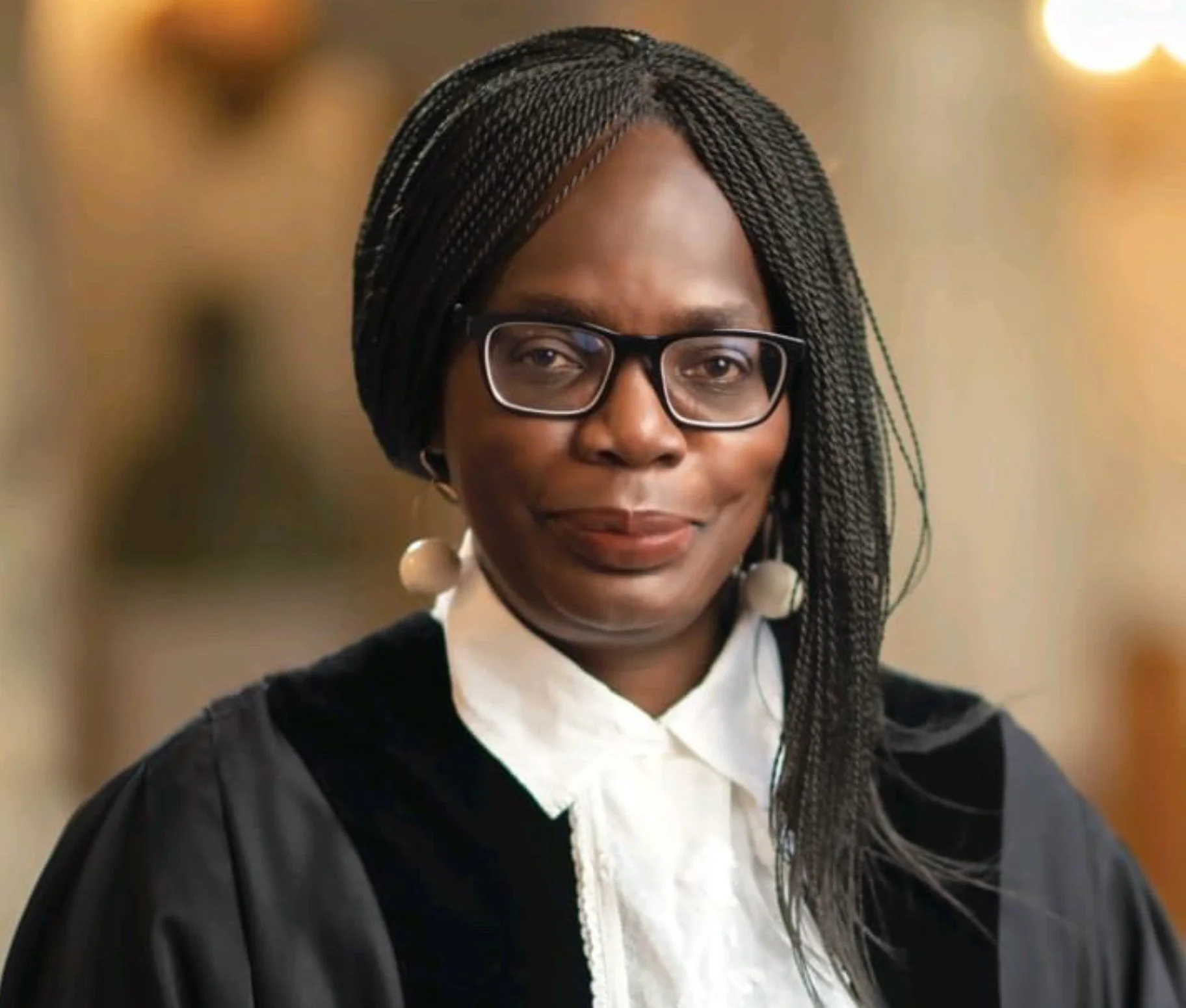
President William Ruto has hailed Kenyan legal scholar Phoebe Okowa after she secured a full nine-year term as a judge of the International Court of Justice (ICJ), marking a major diplomatic victory for Kenya following a competitive election at the United Nations.
Okowa won the backing of both the UN General Assembly (UNGA) and the Security Council, securing 183 votes in the General Assembly and 13 in the Security Council, comfortably surpassing the required thresholds to join the world's principal judicial body.
In a congratulatory message issued on Wednesday, November 4, Ruto described her election as a source of national pride, saying it reflected Kenya's legal expertise and growing contribution to international affairs.
"Your election is a moment of great pride for Kenya and a powerful affirmation of the depth of legal expertise, integrity and excellence that our country continues to contribute to the international community.
"As you take up this distinguished responsibility, we wish you great success in discharging your mandate with diligence and in advancing the ICJ's mission of upholding international law and promoting the peaceful resolution of disputes among nations. Kenya is proud of you."
Her election followed an intense contest involving nine candidates competing for five available positions on the 15-member court.
The process involved separate secret ballots in the UN General Assembly and Security Council, with candidates required to secure an absolute majority in both institutions to qualify for election.
Under the voting rules, a candidate needed at least 97 votes from the 193-member General Assembly and eight votes from the 15-member Security Council.
Although Okowa performed strongly in the initial round, securing 117 votes in the General Assembly, she did not immediately obtain the required majority in the Security Council. The differences in the voting patterns between the two UN organs meant further rounds were necessary to determine the successful candidates.
The race gradually narrowed following withdrawals by several candidates, with Sierra Leone's decision to drop its nominee, Professor Charles Chernor Jalloh, proving particularly important to Okowa's campaign.
Sierra Leone announced its withdrawal at the General Assembly, explaining that the decision was intended to safeguard Africa's representation on the court. The country argued that divided African votes could leave the continent without an available seat.
South Korea's Paik Jin-hyun and Ecuador's Marcelo Vázquez-Bermúdez also withdrew after the third round, further reducing the number of contenders.
In the final ballot, Okowa secured 183 votes in the General Assembly, while Peru's Luz del Carmen Ibáñez Carranza received two votes. Six members abstained.
She also obtained 13 votes in the Security Council, exceeding the minimum requirement of eight and confirming her election through both UN institutions.
Her new nine-year tenure will begin on February 6, 2027, extending Kenya's presence on the international court until 2036.
Kenya's success followed months of diplomatic engagement coordinated by Foreign Affairs Principal Secretary Abraham Korir Sing'Oei, who led efforts to rally support from UN member states.
The government officially launched Okowa's candidature in January 2026 before stepping up its campaign as the election approached.
Part of the lobbying effort included a diplomatic reception in New York on October 28, where Kenya sought to persuade member states to back her bid.
During the campaign, the Ministry of Foreign Affairs highlighted her professional experience, legal knowledge, independence and integrity as qualities that made her suitable for the position.
Her victory attracted congratulatory messages from Kenyan and international representatives, with Sing'Oei thanking UN member states for supporting the country's candidate.
He also recognised Sierra Leone, South Korea and Ecuador for withdrawing their nominees, saying their decisions helped facilitate the electoral process.
Sierra Leone's Permanent Mission to the UN equally congratulated Okowa alongside the other successful candidates, while the President of the UN General Assembly formally acknowledged her election after she obtained the required majority in both voting chambers.
Okowa is a professor of public international law at Queen Mary University of London and an advocate of the High Court of Kenya.
She obtained a first-class law degree from the University of Nairobi in 1987 before proceeding to the University of Oxford, where she earned a Bachelor of Civil Law degree and a doctorate.
Her election to the United Nations International Law Commission in 2021 marked another major milestone in her career, making her the first African woman to join the expert body tasked with developing and codifying international law.
She had previously joined the ICJ in November 2025 after being elected to fill the vacancy created by the resignation of Somali judge Abdulqawi Ahmed Yusuf.
However, that appointment only allowed her to serve the remaining period of Yusuf's tenure, which expires in February 2027. The latest election therefore gives her a fresh nine-year mandate on the court.
Established in 1945 and headquartered in The Hague, Netherlands, the International Court of Justice consists of 15 judges who serve nine-year terms.
Its primary responsibility is to resolve legal disputes between countries and provide advisory opinions on matters of international law when requested by authorised United Nations institutions.
The ICJ is different from the International Criminal Court, which prosecutes individuals accused of serious international crimes. The ICJ primarily handles cases involving disputes between sovereign states.
Although elected through a process involving their home countries, ICJ judges serve independently and are not representatives of their respective governments.