
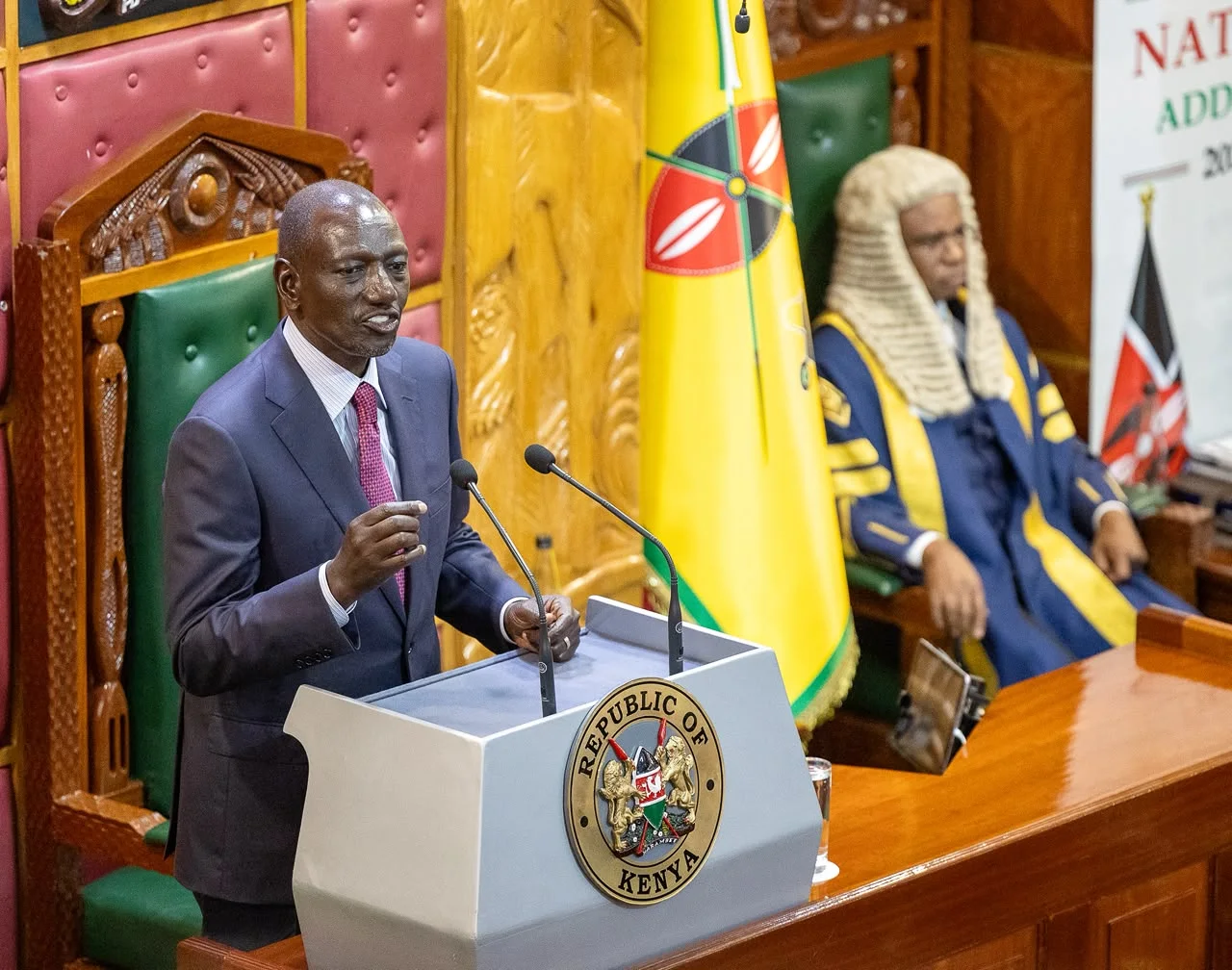
President William Ruto has warned police officers against abusing their powers during security operations, saying those who use excessive force or violate the law must face accountability as the government moves to strengthen policing standards and protect citizens' constitutional rights.
Speaking during his 14th State of the Nation Address before a joint sitting of Parliament on Wednesday, November 18, 2026, Ruto said security agencies had a constitutional duty to protect lives and property but must carry out their responsibilities within the limits of the law.
The President stressed that maintaining public order should not be used as an excuse to violate citizens' freedoms, particularly during demonstrations and public gatherings.
"Our security agencies have a constitutional mandate to secure human life and property. This mandate is constitutional and lawful. And in the discharge of this cardinal duty, respect for the authority of the police to act independently is also constitutional and lawful," Ruto said.
However, he maintained that police officers must equally answer for their actions whenever they exceed their powers or subject members of the public to unlawful force.
"But we must also be unequivocal about the responsibility of the state, where security officers use unlawful force or exceed their authority. Wrongdoing must be acknowledged, and those responsible must be held accountable in accordance with the law," he added.
Ruto's remarks come against the backdrop of continued scrutiny of police conduct during public demonstrations, particularly the June 2024 protests against the Finance Bill and subsequent anti-government protests.
The President acknowledged the heavy toll of the demonstrations, which resulted in deaths, injuries, destruction of property and disruptions to businesses and public institutions.
"We must confront the painful events of June 2024 and subsequent protests with honesty, compassion, and a clear determination to learn from them," he said.
"Kenyans lost their lives. Others suffered serious injuries and lasting trauma. Families were devastated. Parliament was breached. Public institutions, including the judiciary, were attacked. Businesses were looted, and livelihoods destroyed."
He said the events highlighted the need for security agencies to maintain peace without disregarding the constitutional freedoms enjoyed by Kenyans.
In particular, Ruto pointed to Article 37 of the Constitution, which protects the right of citizens to assemble, demonstrate, picket and present petitions to public authorities peacefully and without carrying weapons.
"Article 37 of our constitution guarantees the right of every person peacefully and unarmed, to assemble, demonstrate, picket, and present petitions to public authorities. We must always protect that right," Ruto said.
He further insisted that citizens should be able to challenge government decisions and express opposing views without being subjected to unlawful restrictions.
"Kenyans must remain free to express disagreement and criticize their government," he stated.
The Head of State also highlighted his administration's efforts to compensate people affected by human rights violations during protests, including cases dating back to 2017.
He said the government had set aside Sh2 billion for compensation and established a panel to verify claims before payments could be made to victims and affected families.
According to Ruto, the panel had, by July 2026, disbursed Sh1.2 billion to 1,476 verified beneficiaries.
The beneficiaries included 1,036 civilians affected during protests and 356 police officers who suffered injuries while performing their duties.
While acknowledging that monetary payments could not undo the damage suffered by victims and their families, Ruto said the government had a responsibility to recognise wrongdoing and provide redress.
"For both demonstrators and police, no compensation can restore a lost life or erase the suffering of a family, but acknowledging harm, acknowledging harm, and providing lawful redress are important responsibilities for a state that respects its citizens," he said.
He was, however, clear that the compensation programme would not shield officers or other individuals implicated in unlawful actions from facing justice.
"Equally, compensation does not replace accountability. Investigations must continue, and prosecutions must follow for violations of the law wherever the evidence warrants," Ruto added.
Beyond compensation, the President announced plans to strengthen the country's public order management systems through improvements in police training, professional conduct and oversight.
The proposed changes will also address officers' welfare, the equipment available to security agencies, command structures and procedures for reducing tensions during demonstrations.
Ruto said the reforms were aimed at building a professional police service that could prevent violence, safeguard lives and property, and respect the freedoms guaranteed under the Constitution.
"This includes improved training, professional standards, officer welfare, appropriate equipment, clear operational command, de-escalation procedures, and stronger oversight," he said.
"Our goal is to have a professional security service capable of preventing violence, protecting life, and protecting property while safeguarding constitutional freedoms and maintaining public order."
He reiterated that the responsibility to maintain law and order must go hand in hand with the duty to protect the rights and freedoms of every Kenyan.