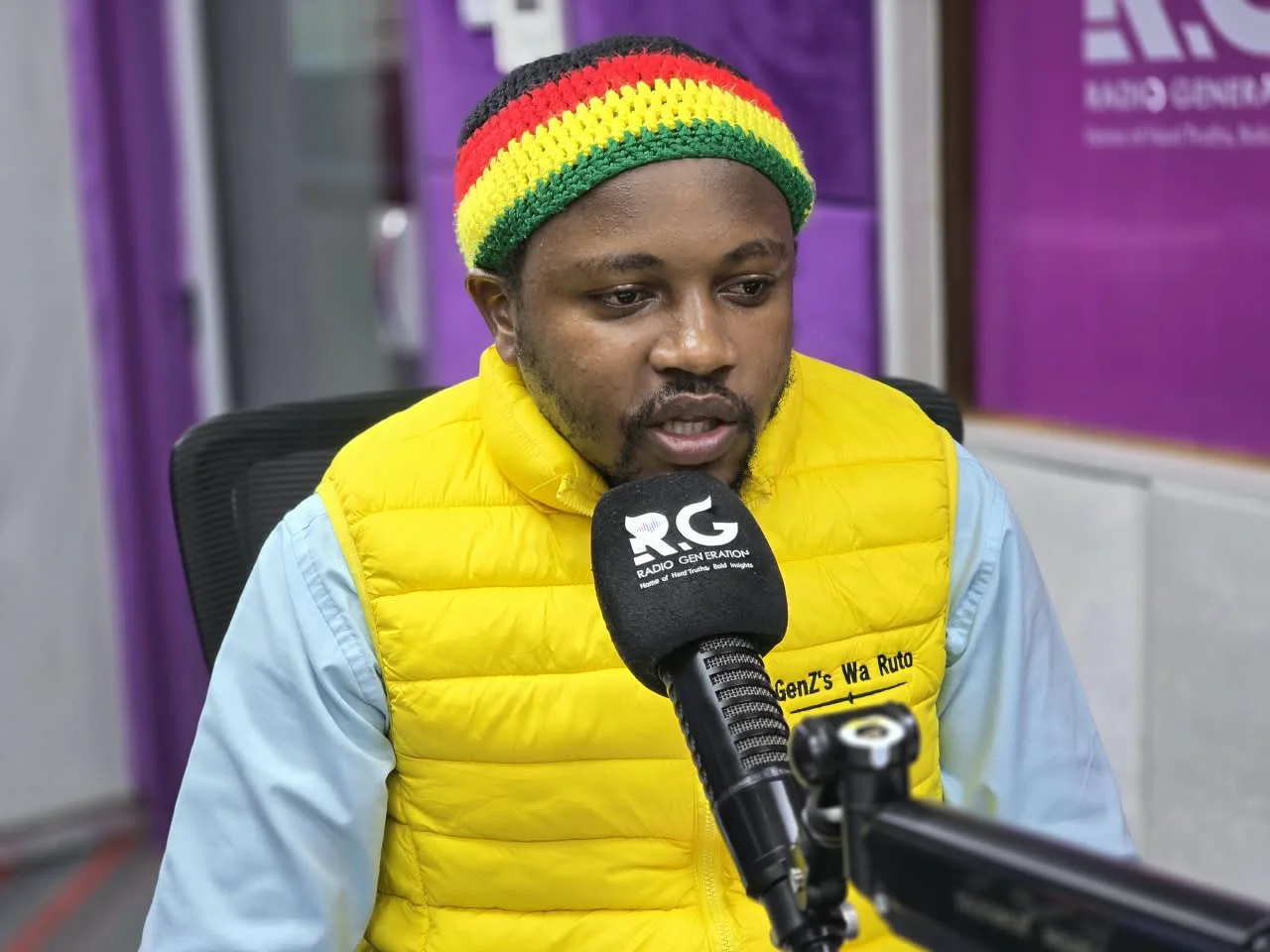
UDA Gen Z Party leader Omwansa M. Omwansa has defended President William Ruto’s record, pointing to ongoing infrastructure projects, public engagement and government programmes as evidence that the administration is responding to concerns raised by Kenyans.
Speaking on Radio Generation on Friday, Omwansa said criticism from the opposition had at times drawn public attention to projects being undertaken by the government, arguing that the developments offered an opportunity to assess the administration’s performance.
He said the government had become more responsive to public concerns, particularly after the 2024 protests, and had taken steps to meet constitutional requirements such as public participation.
Omwansa cited the Affordable Housing Programme, saying the government had followed constitutional requirements while implementing its projects.
“Many, many of our projects have followed the law. It is in the public domain right now. Even after 2024, the government has been woke, you know, to ensure that because the young people have been working to ensure that the law is being followed, public participation, you know, name them and all that.”
His remarks come more than two years after the anti-Finance Bill protests that began in June 2024 following government proposals to raise additional revenue.
On June 26, 2024, President Ruto announced that he would not sign the Finance Bill and called for its withdrawal, saying he had listened to concerns raised by Kenyans.
The protests were, however, marked by deaths, injuries, abductions and enforced disappearances. The Kenya National Commission on Human Rights recorded 39 deaths and 361 injuries by July 1, 2024.
Human Rights Watch later reported that Kenyan security forces had abducted, arbitrarily arrested, tortured and killed people perceived to be protest leaders between June and August 2024.
In December 2024, KNCHR reported at least 63 people had been killed and 87 abducted between June and October, according to Human Rights Watch.
Omwansa said criticism of major government projects could also bring attention to developments taking place across the country.
“When you stand inside a church and claim that the old Bomas of Kenya has been sold to a Turkish businessman, then in months we see how a whole new Bomas complex is coming up. It's almost complete. I was there last week.”
The Ruto administration has listed the Bomas International Convention Centre among major projects targeted for completion in 2026.
Omwansa also pointed to the Talanta Sports City stadium at the Jamhuri Sports Complex in Nairobi, saying its construction challenged claims that major government projects were not moving forward.
The 60,000-seater stadium is part of Kenya’s preparations to co-host the 2027 Africa Cup of Nations. As of October 1, 2026, project officials told a Senate committee that construction was about 94 per cent complete, although technical, accessibility and operational issues were still outstanding.
The stadium has also come under scrutiny over its cost and procurement process. An Auditor-General’s report put the contract value at Sh45.85 billion, against an earlier government-approved funding figure of Sh35 billion.
Parliament has also raised questions about the procurement process and the Sh10.85 billion variation.
On roads, Omwansa cited works along the Rironi-Nakuru route as another example of infrastructure development under the Ruto administration.
The Kenya National Highways Authority is pursuing the expansion of the Nairobi-Nakuru-Mau Summit road and the Rironi-Maai Mahiu-Naivasha section through a public-private partnership.
The proposed project covers about 233 kilometres and includes upgrading sections of the road to dual carriageway.
Omwansa further defended government support for the proposed Dangote refinery in Lamu, describing the project as an investment that could create jobs and boost economic activity.
The $16 billion refinery project was officially launched on September 30, 2026, with plans to process up to 700,000 barrels of crude oil per day.
Dangote has said the project could create about 60,000 jobs, although local residents have mounted a legal challenge over land rights and compensation.
On the President’s relationship with young people, Omwansa contrasted Ruto’s engagement during the 2024 protests with that of former President Uhuru Kenyatta.
He pointed to Ruto’s interaction with young Kenyans through an X Space during the crisis as evidence that the President was willing to engage directly with the public.
“When we talk about the rule of law, my president is a listening president. In 2024, when Uhuru Kenyatta was being asked important questions on social media, what did he do? He left Twitter, he left social media and he left Kenya. But we have a leader who came down to engage with us. We went to X Spaces, and as a matter of fact, he listened to us.”
Omwansa also questioned claims connecting political leaders to killings and abductions where responsibility had not been established through investigations or court proceedings.
He said President Ruto had publicly apologised over deaths recorded during the 2024 protests, while arguing that accusations against political leaders should be supported by evidence and handled through the legal system.
Omwansa maintained that the government’s record should be judged through its infrastructure projects, public engagement and implementation of programmes, while rejecting claims he described as lacking evidence against the administration.