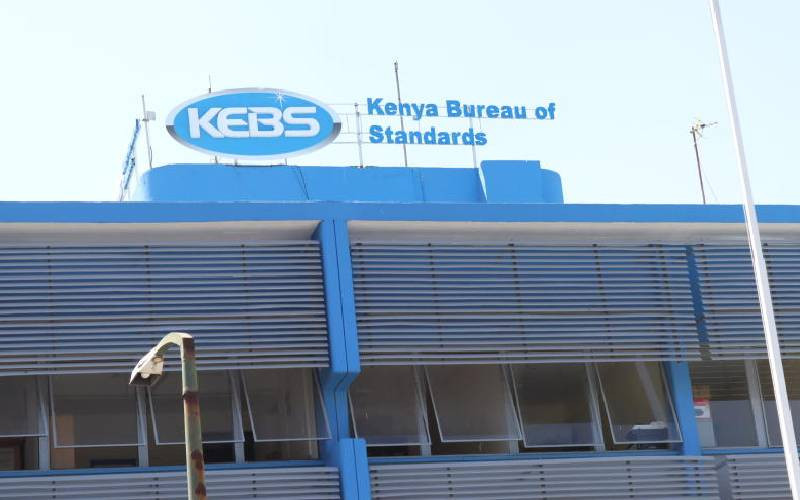
The Kenya Bureau of Standards (KEBS) has issued a firm reminder to all manufacturers across the country to comply with national standards or face strict penalties.
The warning, released on Tuesday, emphasizes that products cannot be produced, imported, or sold without the mandatory Standardization Mark, reinforcing KEBS’s commitment to quality assurance and consumer protection.
In a notice titled “Notice to All Manufacturers,” the bureau underscored that adherence to the Standards Act Cap 496 is compulsory for all companies operating in Kenya.
“Following the gazettement of Standards (Standards Levy Order 2020) and Legal Notice No. 183 dated August 5, 2020, all manufacturers are required to remit to Kenya Bureau of Standards the Standards Levy and ensure their products comply with approved Kenya Standards,” the statement reads.
KEBS warned that failure to meet these requirements could lead to prosecution and removal of products from the market.
“Every manufacturer must obtain a Standardization Mark (SM) licence prior to marketing any product in Kenya. Products, processes, treatments, and installations shall operate under certification,” the notice added.
The directive applies across all production sectors, organized into five main categories: Building and Construction, Textiles, Mechanical Engineering, Electrical Engineering, and Food and Agriculture, including Chemicals and Allied Industries.
In Building and Construction, items like cement, concrete pipes, roofing sheets, paints, and sanitary fittings must meet KEBS-approved standards. Textiles cover products such as uniforms, hospital garments, blankets, mosquito nets, and leather shoes.
Mechanical Engineering includes automotive spare parts, industrial machinery, LPG cylinders, and metal furniture.
“All manufacturers are required to operate within the Kenya Standard codes and ensure all their production lines undergo regular inspection and product testing,” KEBS emphasized. Electrical Engineering products include cables, batteries, sockets, lighting fittings, and solar devices—industries where substandard imports have previously created safety risks.
The Food and Agriculture category includes both fresh and processed goods such as cereals, dairy products, edible oils, and beverages, which must comply with hygiene and safety standards before distribution.
“No manufacturer shall engage in production or trade of goods that do not meet the prescribed standardization and certification requirements,” the bureau reiterated.
KEBS instructed manufacturers to submit applications for certification through regional offices or via the KEBS website, providing required documents, product samples, and payment of applicable fees.
“All manufacturers are advised to apply for the Standardization Mark Licence (Form S/2) available at the Kenya Bureau of Standards offices or downloadable from the KEBS website,” the notice stated.
The bureau highlighted that the Managing Director may suspend or revoke licences for non-compliance.
“Failure to comply with this notice amounts to an offence under the Act,” KEBS said. “The Managing Director reserves the right to take enforcement measures as provided by law.”
Certification and testing services are available at eight regional offices in Nairobi, Coast, South Rift, Lake, North Rift, North Eastern, Mount Kenya, and Western.
KEBS encouraged manufacturers to seek guidance from these offices or via email at [email protected] and [email protected]. “Following submission, applicants will be guided by Kenya Bureau of Standards officers on the necessary steps to achieve full compliance,” the notice explained.
KEBS also reaffirmed that all certification procedures are conducted under its anti-bribery policy to ensure transparency and fairness. “KEBS implements an Anti-Bribery Management Policy accessible through the KEBS website,” the notice concluded.
The reminder comes as manufacturers prepare for the busy end-of-year production period, making it clear that non-compliance will lead to fines, product recalls, or legal action as the bureau strengthens enforcement of national standards.