North Eastern Kenya, a land of vast horizons, remains one of the country’s most neglected conservation frontiers despite its immense wildlife richness and ecological value.
Wajir spans 55,841 square kilometres, Garissa 44,175, and Mandera 25,992, landscapes the size of countries, not counties.
These vast areas are home to rich wildlife, resilient communities, and untapped conservation potential.
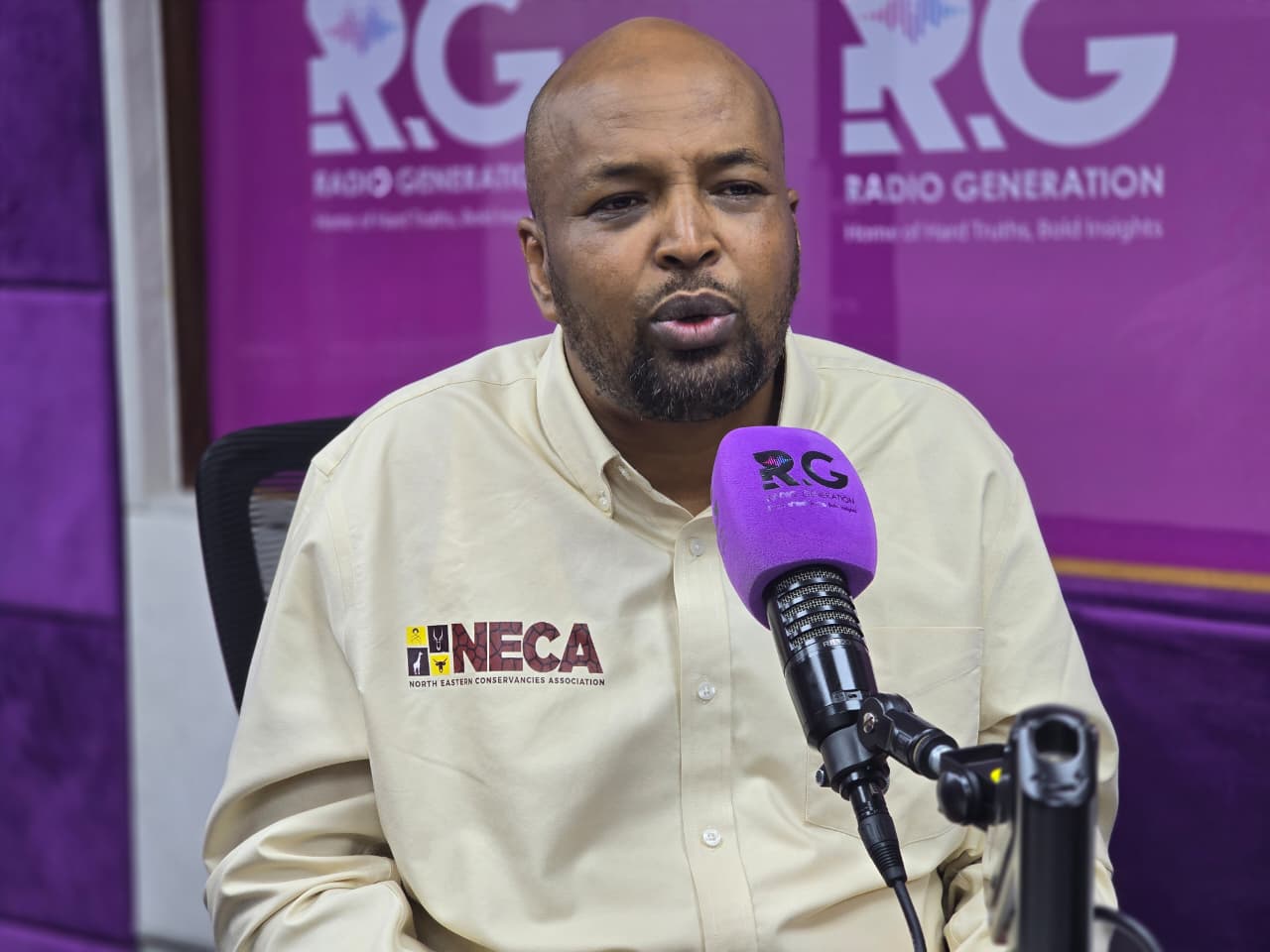
According to Sharmake Mohamed Sheikh, the CEO of the North Eastern Wildlife Conservancies Association (NECA), the region is home to one of Kenya’s richest and most diverse wildlife populations, with rare species found nowhere else in the world.
During an interview with Radio Generation on Thursday, he said that contrary to public belief, counties in the region, including Garissa, Wajir, and Mandera, have thriving wildlife ecosystems comparable to popular destinations such as the Maasai Mara and Amboseli.
Mohamed said data from the last wildlife census in 2021 showed Garissa ranked fourth nationally in wildlife population after Maasai Mara, Amboseli, and Laikipia, while Wajir followed closely at number seven.
“A lot of people don’t know that,” he said, adding that Mandera was also not far behind. “The entire region has a lot of wildlife, all the wildlife and some extra,” he said.
The 2021 National Wildlife Census confirmed that Garissa and Wajir are major strongholds of the reticulated giraffe, while Garissa also hosts the world’s last viable Hirola population.
However, Mohamed warned that these animals are disappearing fast, with recent reports of giraffes being killed across Wajir, Garissa, and Mandera.
He said institutional neglect had become normal, with the region holding some of Kenya’s largest wildlife populations yet receiving the least protection and funding.
Among the unique species found in the region are the Somali giraffe, Grevy’s zebra, and the Hirola antelope, one of the rarest antelopes in the world with only about 400 to 500 remaining.
“They are only found in Garissa and a few that were translocated way back to Tsavo,” he explained.
Going further, Mohamed said the region falls within the Somali-Maasai biome, a unique ecological zone stretching from northern Kenya into Somalia and Ethiopia, known for distinct wildlife species that differ from those in southern Kenya and Tanzania.
“The giraffe you see in Maasai Mara is a Maasai giraffe, but as soon as you cross Nanyuki, it becomes a Somali giraffe. The same applies to ostriches — we have the Maasai ostrich and the Somali ostrich,” he explained.
He added that the region is also home to gerenuks, common zebras, cheetahs, and buffalos, among other species, showing that the north is equally rich in wildlife.
However, he lamented that conservation efforts have lagged behind due to what he termed institutional neglect by both the government and conservation partners.
“Conservation here has not been institutionalized. We have been institutionally discriminated, ecologically speaking. The government has never put a lot of resources, and partners have never been in that place,” he said.
According to him, most wildlife in the region live within community conservancies managed by local people who have coexisted with the animals for generations.
Despite limited support, these communities continue to protect the species under difficult conditions such as encroachment and limited investment.
Mohamed pointed out that while the region has several reserves and parks, they suffer from neglect.
He cited Mankamari National Park in Mandera as an example, calling it a “paper park.”
“It means it exists on paper, but the government has never invested in it properly. KWS has officers in Mandera, but there’s very minimal presence, no investment, nothing,” he said.
The park, he added, has faced encroachment by nearby communities because it has remained inactive for years.
In Garissa, the NECA CEO said, there are three reserves that now fall under the county government.
He explained that under Kenyan law, national parks are managed by the national government through the Kenya Wildlife Service (KWS), while national reserves fall under county governments.
“Maasai Mara, for example, is not a national park but a national reserve under Narok County. Amboseli was a national park until a few days ago when it was reverted back to Kajiado County,” he said.
Even though reserves fall under counties, Mohamed said KWS still plays a key role in protecting wildlife across the country.
“They still have the honorable mandate of protecting wildlife on behalf of Kenyans.KWS will continue to protect wildlife even in the reserves, but they will not be running them directly,” he added.
In conclusion, Mohamed called for more investment and recognition of community-led conservation in the north, saying it is key to protecting Kenya’s rare and endangered species.