
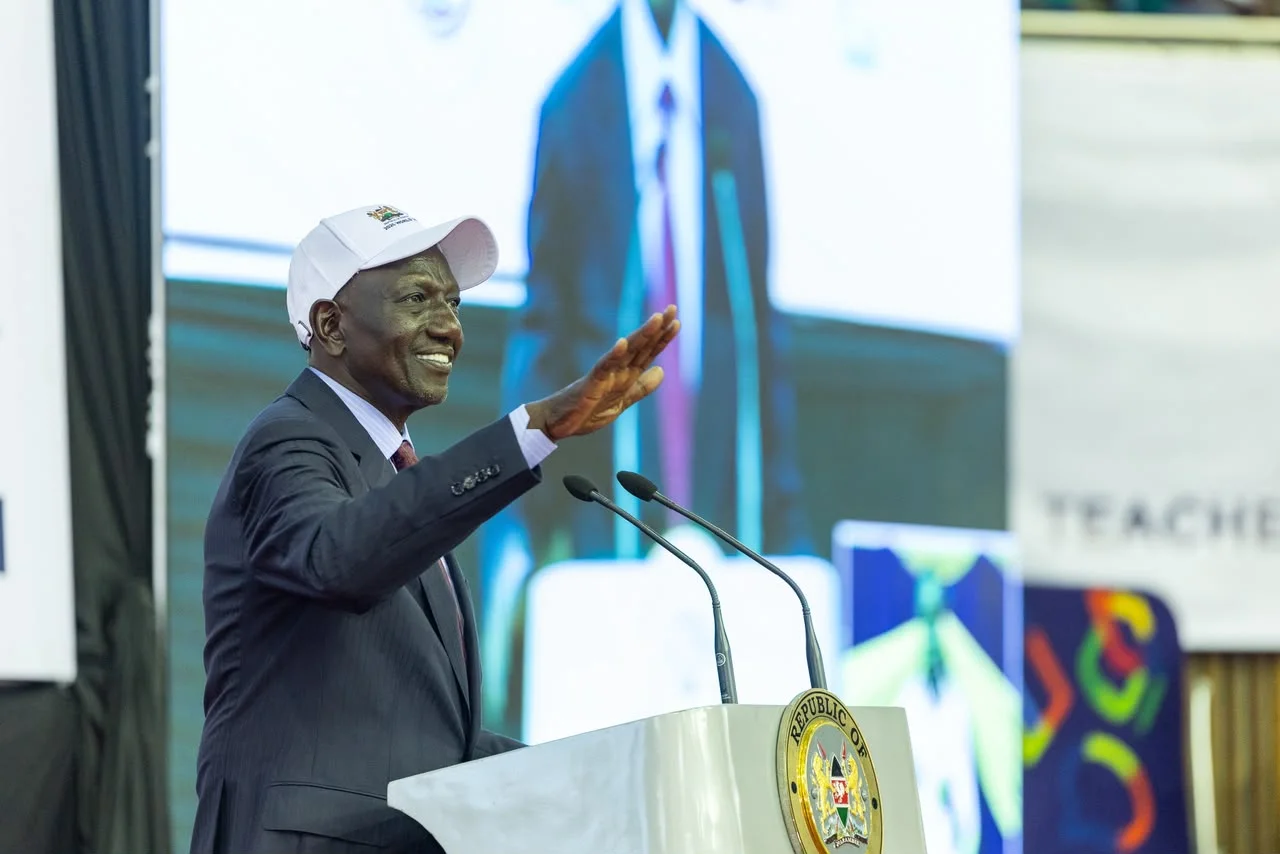
President William Ruto has said teachers will play a central role in the government's efforts to build a knowledge-driven economy, warning that the country’s ability to create jobs and compete globally will depend on the skills produced in classrooms.
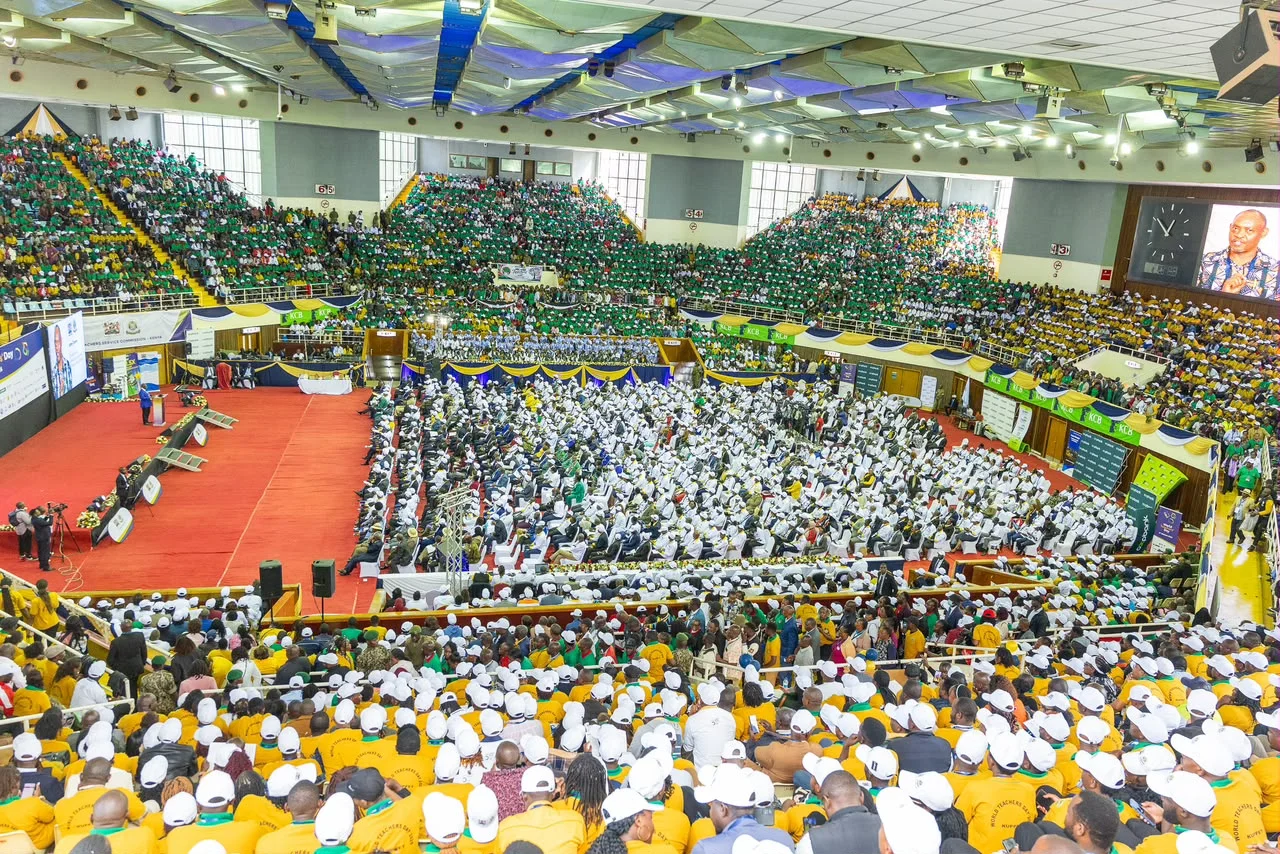
Speaking during World Teachers’ Day celebrations at Kasarani in Nairobi on Monday, the Head of State said Kenya could no longer rely on raw materials and traditional economic activities alone to achieve sustained economic growth.
He explained that the country must export not only agricultural and manufactured products but also the knowledge and skills of its people.
“Kenya must therefore increasingly be able to export not only what we grow and manufacture, but also what our people know and what they can do.”
Ruto linked the development of human capital to productivity, innovation and Kenya’s ability to compete in an increasingly digital global economy.
“No country achieves sustained double-digit growth on raw materials alone. It grows by increasing the productivity of its people by innovating, by producing more value, and by competing successfully in the world, and that journey begins in the classroom,” he said.
The President maintained that Kenya’s expanding services economy, including finance, transport, tourism, health, education, professional services and digital businesses, would require workers with specialised and adaptable skills.
The shift is already reflected in the growing importance of the digital sector. According to the 2026 Economic Survey by the Kenya National Bureau of Statistics, the information and communication technology sector generated Sh404.7 billion in value added in 2025, while its total output stood at Sh728.2 billion. The wider information and communication sector also grew by 4.8 per cent in 2025.
Communications Authority data showed that by June 2025, smartphone penetration had reached 83.5 per cent, while total data subscriptions stood at 58.5 million. 4G and 5G networks covered 97.3% and 30% of the population, respectively.
The Head of State stated that the rapid transformation of technology and the global labour market meant Kenyans would increasingly be able to provide services beyond the country’s borders.
He cited young people developing software for international clients, professionals working remotely and trained medical personnel serving in hospitals abroad.
According to the World Bank, knowledge-intensive global services such as information technology, financial and professional services employ only about 2% of Kenya’s workers but contribute approximately 14% of GDP and 19% of economic growth, highlighting the potential of higher-skilled services.
The Head of State explained that education must therefore equip learners for an economy where digital, scientific and technological capabilities will increasingly determine employment and productivity.
“We need stronger performance in mathematics and science. We need more scientists, engineers, technologists, researchers, and innovators,” he stated.
He challenged teachers to adapt their teaching methods, saying educators must also become lifelong learners as technology changes the workplace.
“Our children cannot learn tomorrow's skills from yesterday's methods. I therefore challenge every teacher to be the first learner in the classroom. Master the digital tools. Model the curiosity you want to see in your learners.”
The call comes as Kenya continues to expand programmes aimed at improving digital inclusion. In August 2026, the Communications Authority announced a Sh100 million programme targeting 120,000 people in 19 counties with practical digital skills for education, employment, entrepreneurship and access to government services. The programme supports the Kenya National Digital Master Plan’s target of equipping 20 million Kenyans with digital skills.
Ruto said science, technology, engineering and mathematics should occupy a central position in education, while institutions including the Centre for Mathematics, Science, Technology and Education in Africa, the Kenya Education Management Institute and the Kenya Institute of Special Education continue supporting teacher development.
He said the quality of education provided today would determine what Kenya can produce, innovate and export tomorrow.
“This is not simply an education agenda; it is an economic transformation agenda,” Ruto said.
Ruto concluded that teachers remain at the centre of Kenya’s economic transformation because every professional contributing to the economy begins their journey in the classroom.