Autopsy reveals strangulation, stabbing in Kitui shallow grave victims
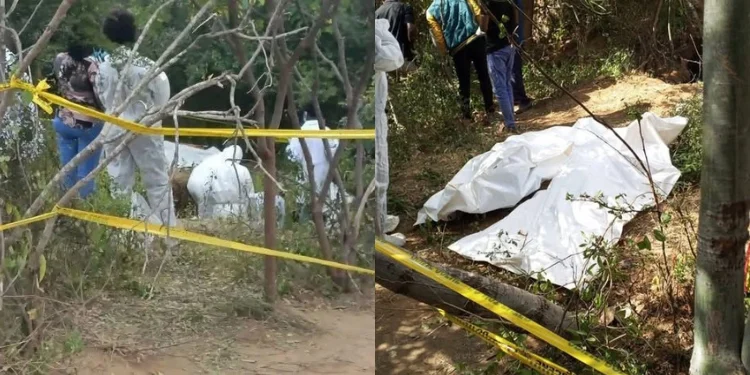
According to the examination results, two of the victims were strangled to death, three suffered severe blows to the head, one had fatal stab wounds to the abdomen, while two others could not be clearly examined because of how badly the bodies had decomposed.
A disturbing forensic report has deepened the mystery around the Mwingi shallow grave case after experts confirmed that the recovered remains point to a series of violent killings involving multiple victims, some strangled, others stabbed or beaten, with one body so damaged it was counted separately due to a missing head.
Government pathologist Johansen Oduor told investigators on Tuesday that what was initially thought to be seven bodies has now been confirmed as eight separate victims, following the recovery of a detached head that did not match the rest of the remains.
The postmortem findings have now painted a picture of extreme violence, with evidence showing different methods of killing used on the victims buried at the site in Kitui County.
"We treated them as eight bodies because one had a detached head found separately. We found two who were strangled, three with head injuries, one with a stab wound to the abdomen, and two where the cause of death could not be ascertained due to advanced decomposition," said Dr. Oduor.
According to the examination results, two of the victims were strangled to death, three suffered severe blows to the head, one had fatal stab wounds to the abdomen, while two others could not be clearly examined because of how badly the bodies had decomposed.
Dr Oduor added that the level of decay suggested the victims had been dead for a considerable period before they were discovered.
"Because of the varying levels of decomposition, it was difficult to estimate, but from a casual look I can say within the last three months," he explained.
The condition of the remains has made identification impossible through visual means, forcing investigators to rely entirely on DNA profiling to determine who the victims were.
Samples have already been forwarded to state laboratories, with authorities now appealing to families with missing relatives to provide DNA samples for comparison.
"When bodies are so decomposed they all look alike. That’s why relatives of missing persons must provide DNA so comparisons can be done," stated Dr. Oduor.
Questions were raised over why the autopsies were conducted in Nairobi instead of Mwingi, but the pathologist defended the decision, citing lack of adequate facilities in the county.
"Knowing the mortuary’s infrastructure and how difficult it would be to conduct autopsies there, we decided to do them in Nairobi. Afterwards, the bodies will be returned to Mwingi for preservation as relatives come forward," he noted.
With forensic work ongoing, detectives are now under pressure to identify the victims, reconstruct their final moments, and establish who was behind the killings.
The discovery has also triggered strong reaction from human rights defenders who say the case reflects a worrying pattern of enforced disappearances and unlawful killings.
"When William Ruto came into power, he promised an end to extrajudicial killings. But from this case and others like the quarry matter, it’s clear the trajectory remains the same as previous regimes. The postmortem results show these people were murdered. We cannot continue with such actions. Remember, after the 2024 protests, people went missing and to this day remain unaccounted for — some buried in unmarked graves, just like in Mwingi," said Vocal Africa activist Brian Olang.
The grim discovery last week sparked panic in parts of Mwingi, with residents demanding urgent action amid fears that more bodies could still be hidden in the area.
Police sealed off the site in Mwingi town as forensic teams carried out exhumations following the initial discovery of a dismembered body on Monday, June 8.
The case has also revived concerns due to earlier findings in the same area, where two mutilated bodies of a man and a woman were recovered barely a month ago, with the woman’s head missing.
Investigators are now working with the possibility that the latest remains could be linked to a wider pattern of killings, as fears grow of either a serial offender or an organised criminal network operating in the region.




Comments
Sign in with Google to comment, reply, and like comments.
Continue with Google