Why dormitories keep burning: Study maps Kenya’s school fire trend
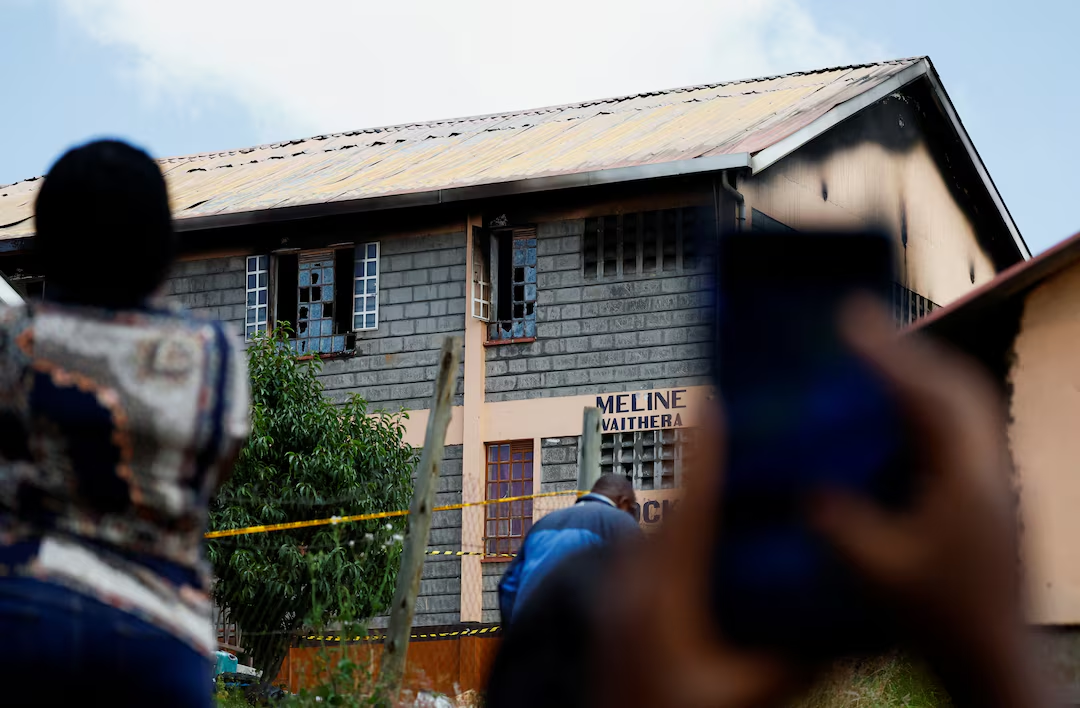
A new analysis by research and advisory firm OdipoDev, which examined 155 reported school fire cases between January 2020 and June 2026, shows that dormitories were affected in 78 per cent of all incidents.
A six-year review of school fire incidents in Kenya is pointing to a troubling pattern that keeps repeating itself: when unrest breaks out, it is student sleeping quarters that are most often reduced to ashes, far more than any other part of a school.
A new analysis by research and advisory firm OdipoDev, which examined 155 reported school fire cases between January 2020 and June 2026, shows that dormitories were affected in 78 per cent of all incidents.
The data places dorms at the centre of the crisis, far ahead of classrooms at 5.1 per cent, stores at 2.3 per cent, administration blocks at 1.7 per cent, while libraries accounted for less than one per cent.
The study further shows that more than 99 per cent of the fires happened in boarding schools. Of these, 96 per cent were in public institutions, while 90 per cent of all incidents were confirmed to be cases of arson.
The findings raise renewed concern over why dormitories continue to be the main point of destruction whenever school unrest erupts.
Elimu Bora Working Group Policy and Strategy Advisor Boaz Waruku says the pattern reflects deeper weaknesses in how safety rules are enforced in schools.
"The continued occurrence of these fires suggests there is some laxity among those charged with enforcing safety standards and conducting inspections in schools," he said.
He adds that the repeated targeting of dormitories may also signal frustration among students who feel unheard within the school system.
The analysis shows that 55 per cent of all school fire incidents recorded since 2020 happened during the second school term, a period repeatedly associated with unrest.
The report, titled Mapping the Flames: What the Data Tells Us About Kenya’s School Fire Problem, connects the repeated destruction of dormitories to long-standing gaps in infrastructure, safety planning and funding in public boarding schools.
The highest number of incidents was recorded in 2021, when 54 school fires were reported. The wave began between October 19 and November 9 as schools reopened for second term after the Covid-19 disruptions.
The first cases were reported in Migori at Osingo Mixed and St Peter’s Abwao before spreading rapidly to Kwale, Kericho, Busia, Nakuru, Nairobi, Vihiga, Nyeri, Machakos, Kakamega and Kisii. In just 22 days, 21 schools were affected, with 16 of them located within 50 kilometres of another affected institution.
The second largest wave occurred in 2026, with 36 incidents recorded between May 18 and June 7. The report shows the outbreak began in Siaya at Ambira Boys and Maranda High, about 13 kilometres apart, before spreading to Kakamega and later other parts of the country.
Since 2020, at least 42 students have died while 294 others have been injured in school fire incidents. Researchers say most deaths are concentrated in a few major tragedies, including the Hillside Endarasha incident in 2024 and the recent fire at Utumishi Girls Academy.
The year 2024 recorded the third highest wave of incidents, starting between August 26 and September 15, when 13 schools were affected within 21 days. The first cases were reported at Njia Boys in Meru before spreading to Nyeri, Machakos, Nakuru, Isiolo and Nairobi.
The findings come alongside concerns raised in a performance audit by the Auditor-General and a report by Usawa Agenda, both of which highlight poor compliance with fire safety rules, overcrowded dormitories and funding gaps.
The Auditor-General found that some schools still operate dormitories fitted with reinforced metal window grills and inward-opening doors, despite safety guidelines requiring grille-free windows and outward-opening exits.
Other schools were found to have overcrowded sleeping spaces, with double and triple-decker beds installed beyond recommended limits.
The OdipoDev report also shows that 97 per cent of secondary schools surveyed reported that funding levels were not enough to match rising student numbers, leaving little room for investment in safety and security measures.
The study comes as pressure grows on education authorities to address concerns raised by students about the root causes of unrest in schools.
Earlier this week, senior school captains under the Kenya Students Education and Welfare Forum submitted a petition to the National Assembly seeking structured consultation systems at school, county and national levels.
They argued that regular engagement between learners and education stakeholders could help resolve grievances before they escalate into unrest.
In their petition, they asked Parliament to push for formal consultation platforms and direct the National Assembly's Education Committee to hold public hearings involving students, parents, teachers, school leaders, education experts and civil society groups.
The calls come as the recent wave of school unrest appears to have eased, shifting attention to debate among parents, teachers, administrators and government officials over responsibility for the incidents.
Education Cabinet Secretary Julius Ogamba has said that 204 secondary schools were affected by unrest this year, but ruled out any changes to the current school calendar.
The ministry maintains that the affected schools represent about two per cent of all secondary schools in the country, describing the situation as contained but still disruptive.




Comments
Sign in with Google to comment, reply, and like comments.
Continue with Google