Kalonzo unveils ‘people’s budget’ as opposition rejects government’s Sh4.8 trillion budget
The opposition’s alternative fiscal framework proposes Sh4.32 trillion in spending, targeting a reduced fiscal deficit of Sh593.5 billion, equivalent to 2.8 per cent of GDP, compared to the government’s projected 5.3 per cent.
Opposition leaders in Kenya have intensified their criticism of the government’s fiscal direction, unveiling a rival spending framework dubbed the “People’s Budget” that challenges the administration’s Sh4.8 trillion 2026/2027 financial plan.
The alternative proposal, presented under the United Alternative Government umbrella, comes amid heightened political scrutiny as Parliament prepares to debate the national budget, which opposition figures say risks deepening debt and increasing pressure on households.
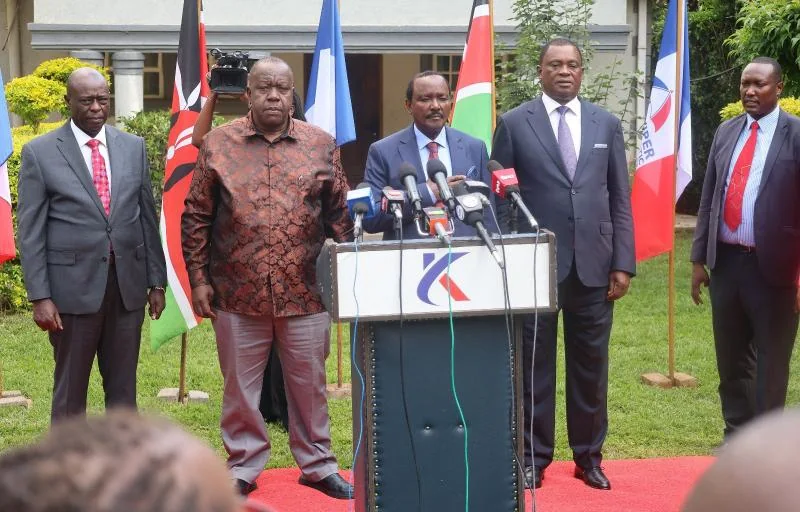
The coalition is led by Wiper Party leader Kalonzo Musyoka, alongside Democracy for Citizens Party leader Rigathi Gachagua, Democratic Party leader Justin Muturi and Jubilee Deputy Party Leader Fred Matiang'i.
They accused the government of prioritising debt repayment over essential public services such as education, health, and job creation.
Kalonzo described the government’s fiscal plan as the largest ever tabled, arguing that it reflects poor judgment and unsustainable priorities.
“I have been in public service for over four decades. I have sat at cabinet tables, at the Office of the Vice President and peace negotiations. I have seen Kenya at its best and I have seen what bad governance does to a people who deserve so much better than they have been given,” he said.
He added: “Nothing, though, in all these years of public life, has prepared me for the cruelty of this budget. Because that is what it is. Not just incompetence and miscalculation but cruelty.”
According to the opposition, the government’s Sh4.82 trillion expenditure plan is anchored on projected revenue of Sh3.63 trillion, creating a financing gap of Sh1.11 trillion expected to be covered through borrowing.
They warn this trajectory will worsen Kenya’s debt burden and constrain future fiscal space.
A major concern raised by the coalition is the Sh1.5 trillion allocated to debt servicing and pensions, which they argue now consumes a disproportionate share of national resources.
“To put that in language every Kenyan understands, interest on domestic debt alone costs more than the entire education budget. We are spending more on paying bankers than on teaching children,” Kalonzo said.
Education funding formed a central pillar of the opposition’s critique. The coalition argued that the government has failed to fully implement free education from primary through secondary school, leaving parents to shoulder increasing costs.
“Free means free. All the way from Class One to Form Four. For every Kenyan child,” Kalonzo stated while outlining the alternative framework.
The coalition also linked rising school unrest and fire incidents in learning institutions to inadequate investment in student welfare systems, safety infrastructure, and mental health support services.
In the health sector, the opposition renewed criticism of the Social Health Authority, describing it as ineffective despite mandatory contributions from citizens.
“SHA, in its current form, is not a health policy. It is a compulsory tax with a hospital logo,” Kalonzo said, arguing that patients continue to face difficulties accessing care despite deductions.
The coalition further questioned a Sh104 billion technology contract tied to the health system, insisting the funds would be better used strengthening hospitals facing shortages of medicines and medical personnel. They pledged to cancel the deal if they assume power.
On taxation, the opposition warned that provisions in the Finance Bill 2026 would increase the cost of living through new levies on digital financial services and mobile devices. They cited proposals including a 16 per cent VAT on mobile money transaction fees and a 25 per cent excise duty on mobile phones at activation.
“The grandmother in Wajir waiting to receive Sh1,000 from her grandson working in Mombasa will pay more for that transfer. The mama mboga in Gikomba paying her supplier through M-Pesa will pay more,” Kalonzo said.
The coalition also raised concerns over expanded Kenya Revenue Authority powers to access taxpayer data, warning of potential overreach in monitoring citizens’ financial activity.
In addition, they accused the government of considering the sale of key national assets, including the Kenya Ports Authority and a stake in Safaricom, arguing that such decisions require full public participation and stronger safeguards.
“These are our crown jewels. They are what this country built across generations,” Kalonzo said.
The opposition’s alternative fiscal framework proposes Sh4.32 trillion in spending, targeting a reduced fiscal deficit of Sh593.5 billion, equivalent to 2.8 per cent of GDP, compared to the government’s projected 5.3 per cent.
It prioritises increased allocations to education and health, revival of programmes such as Linda Mama and Edu Afya, a Sh80 billion youth employment initiative, and scrapping of the Affordable Housing Levy alongside proposed mobile money taxes.
The plan also proposes cuts to expenditure at State House and the National Intelligence Service, with redirected savings going into irrigation and food security. It further advocates a Single Treasury Account to curb wastage, ghost payments and pending bills.
“We will also implement a Single Treasury Account to eliminate ghost workers, duplicate payments and pending bills that are an Auditor General-verified leakage of Sh250 billion per year,” Kalonzo stated.
He added: “Every contract requires confirmed exchequer backing before work begins. Any accounting officer with an adverse Auditor-General report must step aside immediately.”
Kalonzo further faulted the government for not allocating funds for victims of the June 2024 anti-government protests, saying the budget ignores compensation and rehabilitation needs.
He urged Members of Parliament to reject the proposed fiscal framework, warning against approving measures that increase pressure on ordinary citizens.
“You were not elected to be a rubber stamp. A mother woke before dawn, walked to a polling station, queued for hours, and marked your name because she believed you would go to Nairobi and fight for her,” he said.
The coalition maintained that the “People’s Budget” is designed to ease household pressure while improving accountability and redirecting spending toward social priorities.




Comments
Sign in with Google to comment, reply, and like comments.
Continue with Google