No evidence MPs, Senators were biased against Gachagua, Court rules
The judges noted that impeachment proceedings are by nature political and constitutional processes, making it unrealistic to expect legislators to participate without prior knowledge of the issues or without having already formed political views.
The High Court has dismissed claims that the impeachment of former Deputy President Rigathi Gachagua was driven by bias, predetermination or conflicts of interest, ruling that petitioners failed to provide evidence showing that lawmakers acted outside their constitutional mandate during the process.
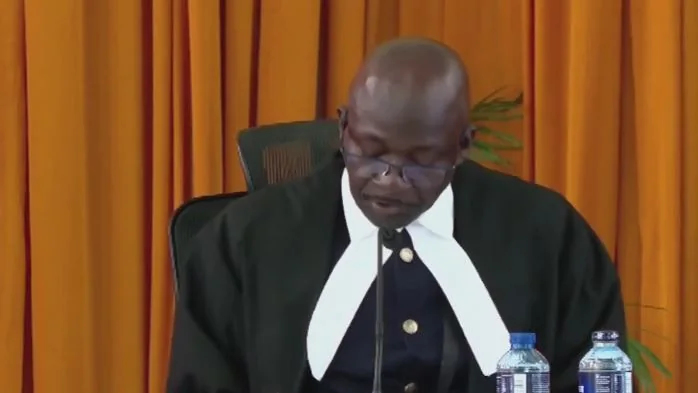
Delivering the judgment on behalf of a three-judge bench on Monday, Justice Eric Ogola said the allegations levelled against the Speakers, Members of Parliament and Senators were not supported by material evidence and could not be sustained on the basis of political suspicions or inferences alone.
"The mere fact that members supported or opposed the impeachment of His Excellency Gachagua cannot, standing alone, establish constitutional bias," the court stated.
The judges noted that impeachment proceedings are by nature political and constitutional processes, making it unrealistic to expect legislators to participate without prior knowledge of the issues or without having already formed political views.
"Legislators are not expected to approach impeachment as blank slates, devoid of political opinion or prior knowledge," Ogola noted.
The court explained that the Constitution does not require elected representatives to be free from political leanings. Instead, lawmakers are expected to remain open to considering evidence and arguments presented during the proceedings while carrying out their duties in good faith.
"What the Constitution requires is that they remain genuinely open to considering the evidence, listening to argument, and discharging their constitutional responsibilities in good faith and within constitutional limits," the judge said.
Based on that standard, the bench found no basis for claims that Members of Parliament or Senators had already decided the outcome of the proceedings before hearing the case or that they acted under a conflict of interest.
"We therefore find that the allegations of bias, predetermination and conflict of interest advanced by the petitioners against the Speakers, Members of Parliament and Senators are, on the material before this Court, no more than bare and unsubstantiated assertions grounded in political inference and suspicion rather than in objective evidence," Justice Ogola ruled.
The judges further stated that constitutional standards should not be interpreted to mean that elected representatives must have no political opinions when undertaking impeachment proceedings. The key question, they said, is whether decision-makers fairly considered the evidence before them and acted within the limits set by the Constitution.
On the wider constitutional questions raised in the petitions, the court held that impeachment proceedings can be examined by the judiciary where claims of constitutional violations are brought before it.
"We find that the impeachment proceedings challenged in these petitions are justiciable, and that this Court possesses jurisdiction under Articles 23, 22 and 165 of the Constitution to determine whether the National Assembly and the Senate acted within constitutional bounds," Ogola stated.
At the same time, the bench stressed that its role is limited to examining whether constitutional procedures were followed and does not extend to determining the political merits of impeachment charges.
"We reiterate that the Court is not a political arbiter but a constitutional one," the judge said.
Justice Ogola said the judiciary cannot replace Parliament's judgment with its own view on whether allegations against a State officer are serious enough to justify removal from office.
"We agree in principle with the submission that it is not the function of this Court to determine whether the charges against His Excellency Gachagua were of sufficient gravity to warrant his removal from office," he observed.
The judges also reaffirmed the principle of separation of powers, saying it should not be interpreted as shielding Parliament from constitutional scrutiny by the courts.
"The separation of powers does not mean separation from the Constitution," Ogola concluded, reinforcing the judiciary’s role in ensuring constitutional compliance while respecting Parliament’s institutional responsibilities.




Comments
Sign in with Google to comment, reply, and like comments.
Continue with Google