Africa must rethink and adapt new approaches in mediation
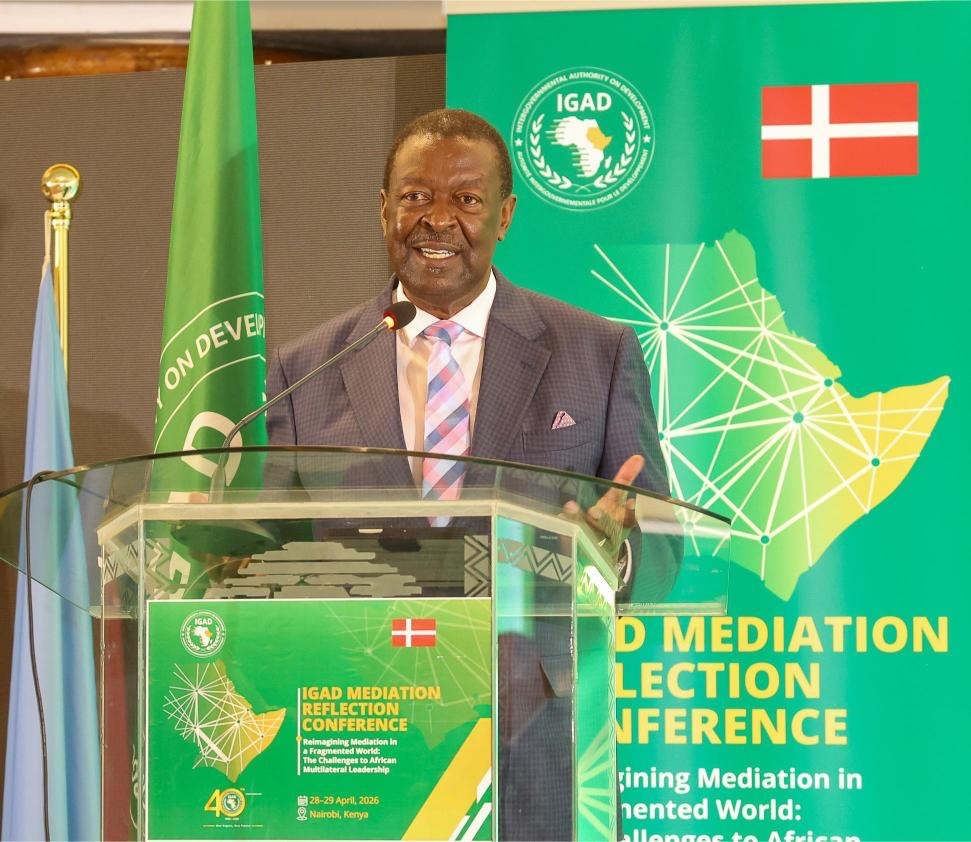
Mudavadi said mediation processes are increasingly being treated as transactional ventures, eroding their core objective of securing lasting peace.
Prime Cabinet Secretary Musalia Mudavadi has called for a fundamental shift in how conflicts are resolved across Africa, warning that the growing commercialisation and privatisation of peace initiatives is undermining genuine efforts to restore stability.
Speaking at the Intergovernmental Authority on Development (IGAD) Mediation Reflection Conference in Nairobi, Mudavadi said mediation processes are increasingly being treated as transactional ventures, eroding their core objective of securing lasting peace.
“We are seeing an emerging trend where factions are turning into arbitrators of transactions instead of genuinely pursuing efforts that will restore peace and stability in the affected nations and regions,” he said.
Mudavadi cautioned that the shift toward profit-driven or politically expedient mediation risks redefining sovereignty and weakening the integrity of conflict resolution frameworks.
“We are now seeing sovereignty facing a new definition other than the description of a self-governing state independent of outside control,” he added.
The conference, convened by Intergovernmental Authority on Development (IGAD), has brought together regional leaders, diplomats, and international stakeholders to reassess mediation strategies in the Horn of Africa amid increasingly complex and protracted conflicts.
Mudavadi emphasized that Africa must urgently rethink and adapt its mediation approaches to reflect evolving realities, including fragmented conflicts, shifting geopolitical dynamics, and growing pressure on multilateral institutions.
“Africa must rethink and adapt to new approaches in pursuing more flexible and responsive mediation frameworks, tailored to the specific contexts of the continent,” he said.
He noted that traditional peace processes are being strained by the fragmentation of actors and duplication of initiatives, which often undermine coordinated efforts.
According to Mudavadi, stronger regional leadership—anchored on IGAD—is essential to restoring coherence and effectiveness.
“It is important to enhance coordination among regional and continental actors. Therefore, a more harmonized approach, anchored on IGAD’s leadership, will strengthen coherence and effectiveness in the Horn of Africa,” he said.
The Prime Cabinet Secretary also stressed the importance of African ownership in resolving the continent’s conflicts, arguing that sustainable peace can only be achieved when solutions are driven internally.
“African ownership in addressing African conflicts remains essential in ensuring legitimacy, sustainability, and long-term success,” he noted.
Mudavadi further warned against the tendency to undermine African institutions tasked with peace and security roles, singling out the African Union (AU) and IGAD as critical pillars that require stronger support from member states.
“It is disturbing to see the people who tend to discredit African institutions like the AU being Africans themselves,” he said.
“You get a reasonable proposition coming from the AU, and we completely refuse to look at it… but when the same is taken to other parties outside Africa, they call you, give you the same document you refused to adopt while at home and you comfortably sign onto it. This must stop.”
While acknowledging the role of international partners in supporting peace efforts, Mudavadi maintained that external involvement should complement—not replace—African-led initiatives.
“Safeguarding the integrity of African-led mediation requires ensuring that external engagement is aligned with, and advances, our collective objectives,” he said.
“Support from international partners should remain complementary and supplementary, not foundational.”
The Cabinet Secretary also highlighted the economic cost of persistent conflicts across the continent, noting that instability continues to hinder Africa’s ability to fully exploit its natural resources.
“We have gas in Tanzania and Mozambique. We have oil reserves in Sudan and other parts of Africa, but we cannot explore these resources for the benefit of the continent due to conflicts,” he said.
“Right now, the Middle East is in a crisis… but back home we can’t get value of our reserves because we haven’t strengthened coherence and effectiveness in addressing our conflicts.”
Mudavadi urged African leaders and citizens alike to embrace shared responsibility in promoting peace, stressing that regional cooperation, political transition, and humanitarian diplomacy must remain central to conflict resolution efforts.
The IGAD conference comes at a time when the Horn of Africa is grappling with multiple, interconnected crises, including the ongoing conflict in Sudan.
Participants at the forum include IGAD Executive Secretary Workneh Gebeyehu, African Union representative Mohamed Belaiche, and former Sudan Prime Minister Abdalla Hamdok.



Comments
Sign in with Google to comment, reply, and like comments.
Continue with Google