Infantino defends World Cup hydration breaks amid fairness and flow concerns
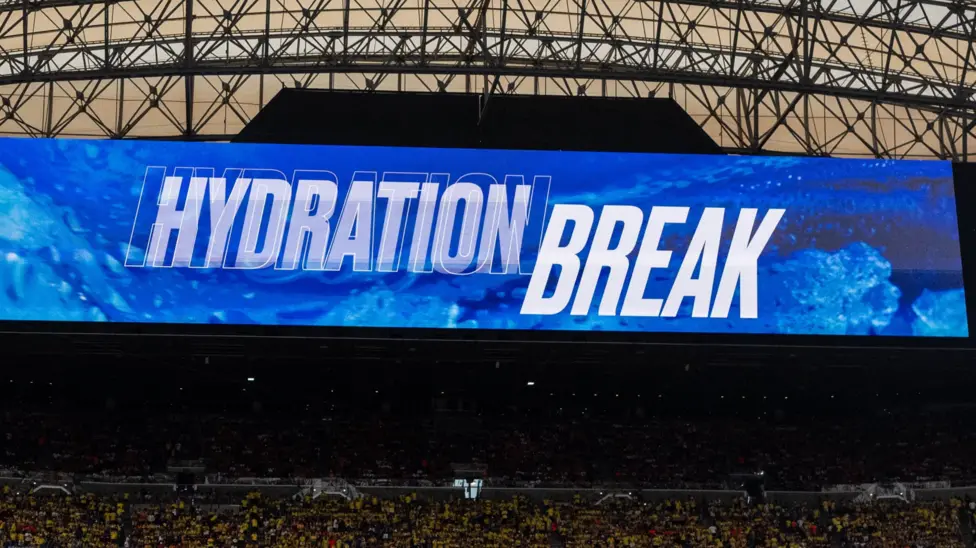
Gianni Infantino has defended the policy, saying Fifa’s intention is not commercial and that all broadcasting deals were agreed long before the tournament began.
A debate over the purpose and impact of hydration stoppages at the World Cup has intensified after Fifa president Gianni Infantino dismissed claims that the pauses are linked to any financial benefit, insisting the decision is driven entirely by playing conditions and fairness across matches.
The three-minute breaks introduced in every half of World Cup games were designed to help players cope with extreme heat across stadiums in North America. While the measure was meant to protect player welfare, it has sparked mixed reactions from players, coaches and fans, with some sections of supporters expressing frustration whenever play is halted.
Gianni Infantino has defended the policy, saying Fifa’s intention is not commercial and that all broadcasting deals were agreed long before the tournament began.
He said: "There is no additional revenue for Fifa, as all commercial agreements were signed well in advance.
"This is not a financial issue for us. For us, it is purely a sporting matter."
The breaks have also created unexpected broadcast moments, with television networks in several countries using the pause to air advertisements. This is not done in the United Kingdom, but elsewhere the interruption has become a valuable advertising window.
Industry estimates suggest that a 30-second World Cup advert on Fox Sports goes for between $200,000 (£152,000) and $300,000 (£227,000), rising to about $750,000 (£567,000) during United States matches and the final stages of the competition.
Based on those figures, advertising during hydration breaks could generate more than $250m (£189m) in the United States alone, even though Fifa maintains it does not earn extra income from the pauses.
Some matches, including England’s draw with Ghana on Tuesday, have taken place under less intense conditions, while others have been staged in fully air-conditioned venues with closed roofs, raising questions about whether the breaks are always necessary.
England coach Thomas Tuchel has also expressed concern about how the stoppages affect match rhythm, saying they influence the flow of the game more than expected and give coaches extra time to adjust tactics.
Despite the criticism, Infantino has maintained that the breaks are essential in a tournament stretched over 39 days, with teams potentially playing up to eight matches, and are intended to ensure uniform conditions for all sides.
He added: "The main reason [for the breaks] is the heat, but we also have to understand that in a competition like the World Cup, played over 39 days, with teams potentially playing eight matches in those 39 days, having a moment to rest is extremely important.
"What matters even more to us is ensuring that all teams, in every match, are playing under the same conditions.
"And it's very difficult to accept that a coach might have the opportunity to influence a match by making adjustments simply because it is hotter, while in another match, where the temperature is slightly lower, the same coach does not have the same opportunity.
"We want to ensure equal conditions for everyone and that's why these breaks are implemented in every match."
As discussion continues, the hydration pauses remain one of the most debated additions to the tournament, balancing player welfare, competitive fairness and the viewing experience.




Comments
Sign in with Google to comment, reply, and like comments.
Continue with Google