CS Mbadi defends Sh240 billion Safaricom deal, dismisses Opposition criticism
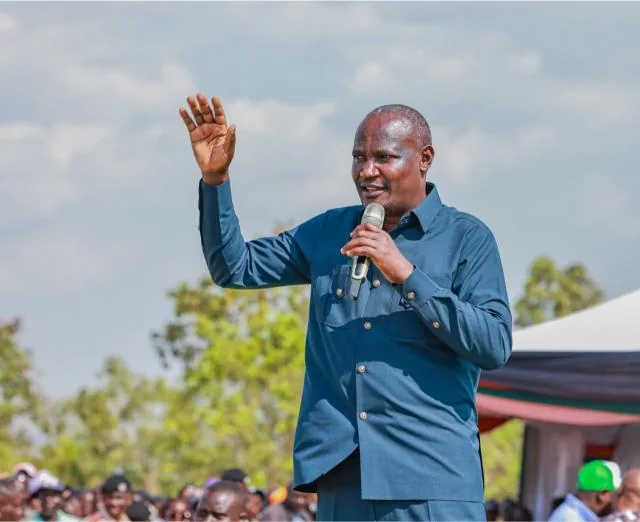
Mbadi said while Kenyans have a constitutional right to challenge government decisions in court, leaders should avoid making conclusive statements on matters that are still awaiting judicial determination.
Treasury Cabinet Secretary John Mbadi has defended the government's sale of part of its Safaricom stake, saying the Sh240 billion transaction was lawful, approved through due process and aimed at financing major infrastructure projects across the country.
Speaking in Kisumu on Saturday, Mbadi dismissed criticism from opposition leaders over the transaction, maintaining that the government followed all legal requirements and would continue to respect the court process surrounding the matter.
He said the sale was a deliberate decision intended to raise resources for the National Infrastructure Fund, which will finance commercially viable projects in key sectors of the economy.
"The action taken by the government in respect of shares in Safaricom is a deliberate strategic move to sustain the social contract between the people and their government. Attempts to confuse the public through misinformation and disinformation cannot remain unchallenged," Mbadi said.
The Treasury CS was responding to concerns raised by opposition leaders who have questioned the legality, timing and valuation of the transaction.
Mbadi said while Kenyans have a constitutional right to challenge government decisions in court, leaders should avoid making conclusive statements on matters that are still awaiting judicial determination.
"The government has participated fully in the proceedings and will abide by the final determination of the court. We have respected every court order issued so far and will continue doing so," he said.
According to Mbadi, the High Court had initially issued conservatory orders halting the transaction before the Court of Appeal lifted the temporary orders, allowing the government to proceed with the sale.
He said the transaction was undertaken under Section 87A of the Public Finance Management Act, 2012, after approval by the National Assembly and public participation conducted in accordance with Articles 10 and 118 of the Constitution.
Mbadi said he personally led public participation forums in Migori, Kakamega, Nakuru, Eldoret, Kiambu, Meru and Kilifi before Parliament considered the proposal.
"I took the initiative to conduct extensive public participation across the country. Parliament also carried out its own public participation through the relevant committees. This was not a rushed process," he said.
He challenged those opposing the transaction to explain how they had sought the views of Kenyans before taking their position.
"I want to ask those who are contesting this divestiture, where have you conducted public participation? You cannot simply sit in your houses and claim to speak for Kenyans without consulting them," he said.
Mbadi accused opposition leaders of turning government programmes into political battles instead of engaging in discussions on economic policy and development.
"They tried to politicise the Finance Bill. They failed. Now they are looking for another issue. Kenyans are becoming more informed and are demanding facts and alternatives instead of propaganda," he said.
The CS also dismissed claims that the reduction of the government's stake in Safaricom had weakened the country's interests in the telecommunications giant, noting that the State was already a minority shareholder before the latest transaction.
"Before this exercise, the government owned 35 per cent of Safaricom, which already made us minority shareholders. Now we own about 20 per cent. We were already minority shareholders," he said.
Mbadi said he supports government divestiture from commercial enterprises where it makes economic sense, arguing that the State should focus on creating an environment that encourages investment and economic growth.
"The government has no business being in business. Our role is to create the right environment for private investment. Around the world, governments do not succeed by running commercial enterprises," Mbadi said.
He also rejected concerns that the government would lose future dividend earnings from Safaricom, saying the amount raised through the transaction far outweighs annual dividend income.
"We are talking about raising approximately Sh240 billion. You cannot delay such a transaction because you are waiting for annual dividends of a few billion shillings. That is not prudent financial management," he said.
Mbadi said the proceeds have already been transferred to the National Infrastructure Fund and will be invested in projects capable of generating long-term economic returns rather than financing recurrent expenditure.
Among the projects expected to benefit are the expansion of Jomo Kenyatta International Airport, major road projects, irrigation schemes and investments in the energy sector.
"If the money is invested in JKIA, Kenyans will see the expanded terminals. If it goes into roads, they will see the roads. We are converting one public asset into another public asset instead of consuming the money through the budget," he said.
The Treasury CS further disclosed that interviews for members of the National Infrastructure Fund board had been completed and appointments would be announced within days.
"We listened to Kenyans. Their biggest concern was accountability, and we have ensured that competent people will oversee the fund," he said.
Mbadi said the government remains committed to the fund and views it as a key tool for financing development and supporting economic transformation.
"The journey has just begun. We are committed to this fund because we believe it is one of the solutions that will drive Kenya's economic transformation. We will not be derailed," Mbadi said.




Comments
Sign in with Google to comment, reply, and like comments.
Continue with Google